

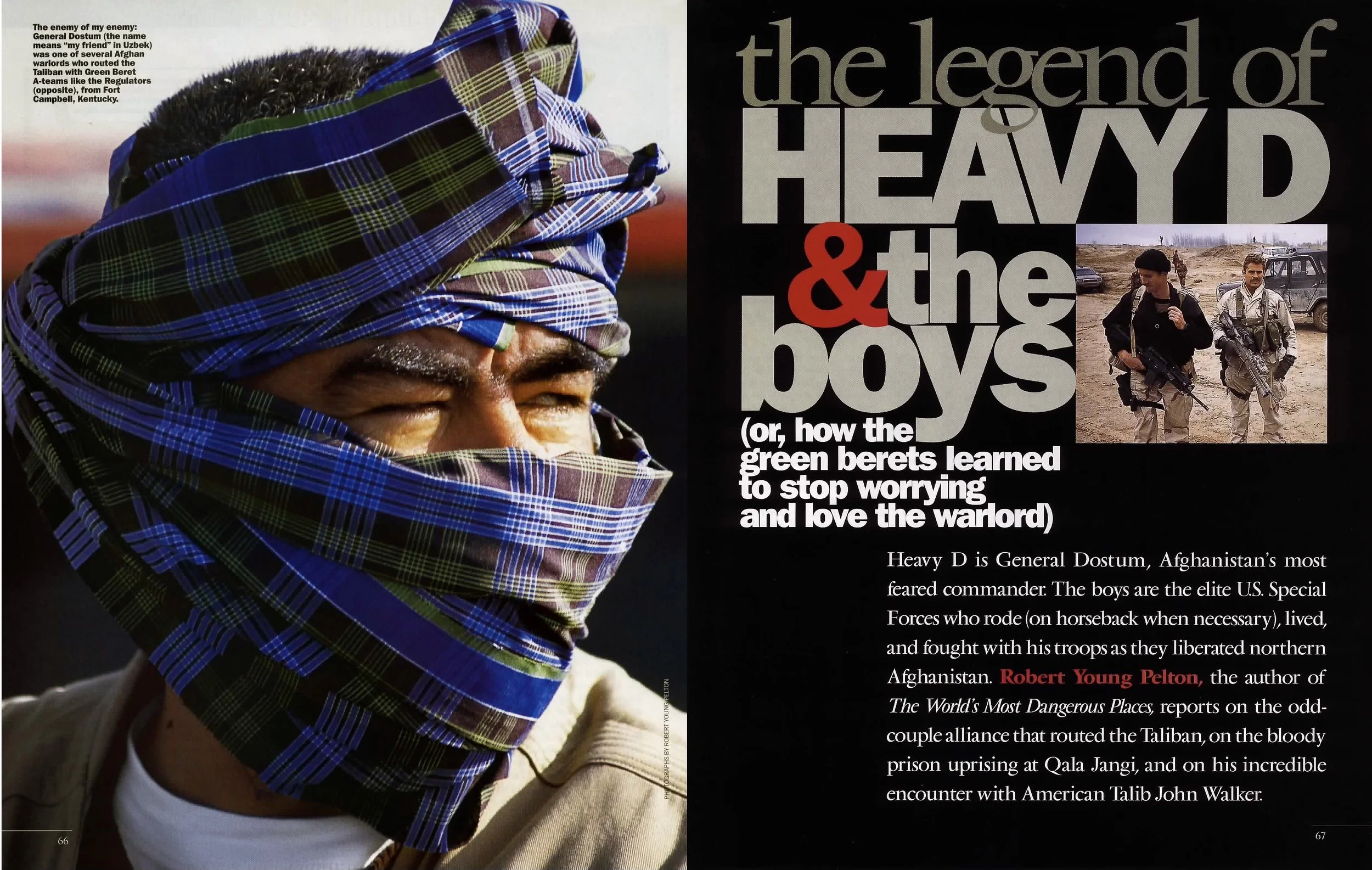
Heavy D and the boys
Robert Young Pelton was the first and only journalist in combat operations with American Special Forces after 9/11. His years of travel into and the warring nation, as well as his bond with General Dostm and the ODA assigned to him, result in an incredible eyewitness account of the opening days in the War on Terror. Pelton also introduced the world to their first American .member of al-Qaeda interviewed in depth after the horrific battle of Qali i Jangi
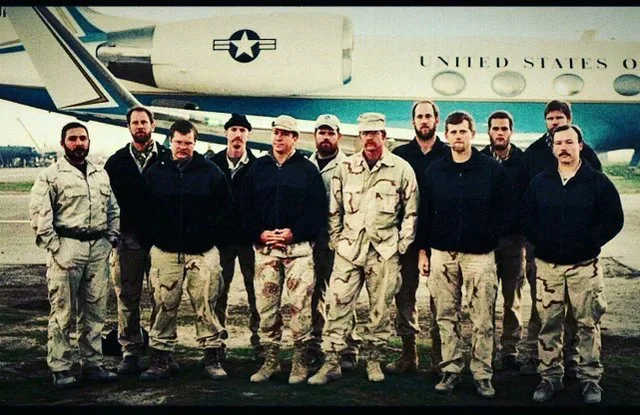
The Regulators are pulled out of country to do a grip and grin with Donald Rumsfeld and meet Robin Moore, the author of the “Green Berets”
How the warlord learned to love the green berets.
The Regulators flew in from Uzbekistan at night on a blacked-out Chinook helicopter and landed near a mud-walled compound in a remote valley in northern Afghanistan. As they began unloading their gear, they were met by Afghans in turbans, their faces wrapped. “It was like that scene in Close Encounters where the aliens meet humans for the first time,” one soldier says later. “Or maybe that scene in Star Wars: These sand people started jabbering in a language we had never heard.” The Americans shouldered their hundred-pound rucksacks while the Afghans hefted the rest of the equipment. The gear seemed to float from the landing site under a procession of brown blankets and turbans.
The next morning, about 60 Afghan cavalry came thundering into the compound. Ten minutes later, another 40 riders galloped up. General Abdul Rashid Dostum had arrived.
“Our mission was simple,” another soldier says. “Support Dostum. They told us, ‘If Dostum wants to go to Kabul, you are going with him. If he wants to take over the whole country, do it. If he goes off the deep end and starts whacking people, advise higher up and maybe pull out.’ This was the most incredibly open mission we have ever done.”
Before heading in-country, the soldiers had been briefed only vaguely about Dostum. They’d heard rumors that he was
80 years old, that he didn’t have use of his right arm. And they’d been told that he was the most powerful anti-Taliban leader in northern Afghanistan. “I thought the guy was this ruthless warlord,” one soldier says. “I assumed he was fricking mean, hard. You know: You better not show any weakness. Then he rides up on horseback with one pant leg untucked, looking like Bluto.”
Dostum dismounted and shook everyone’s hand, then sat on a mound covered with carpets. He talked for half an hour. Dostum’s strategy was now their strategy: to ride roughshod over Taliban positions up the Darra-e Suf Valley, roll over the Tingi Pass in the Alborz Range, then sweep north across the plains and liberate Mazar-e Sharif, Afghanistan’s second largest city. When the council broke up, Dostum stood and motioned toward the horses. America’s finest were about to fight their first war on horseback in more than a hundred years.
The rocket howls over the roof of General Dostum’s house in Khoda Barq at about 10 p.m. It’s November 26, my second day in Afghanistan, and already I’m in the middle of a hellacious firefight. Although nighttime gunfire is normal in Afghanistan, there is an urgency to the sound of the deep explosions that come from the 19th-century fortress of Qala Jangi, just over a mile east from Khoda Barq, a Soviet-era apartment complex west of Mazar. The heavy shooting, the worried soldiers, the rapid radio chatter—all signal that something ugly is going on over there.
Meanwhile, I’m hunkered down, waiting for Dostum. I’ve arranged through intermediaries to spend a month with the general, but for the past week, he has been a hundred miles east, trying to subdue Taliban forces that control the city of Kunduz. General Abdul Rashid Dostum is a man who has rarely been interviewed but has often been typecast as a brutal warlord—usually because of his reputation for winning. He is a man who is said by some journalists to define violence and treachery. (In Taliban, author Ahmed Rashid reports a tale he heard that Dostum once ordered his men to drag a thief behind a tank until all that was left was a bloody pulp of gore.) Beyond that, all I know is that Dostum, born a poor peasant, grew up to be a brilliant commander, a general, and a warlord—one of the many regional leaders across Afghanistan whose power derives both from ethnic loyalties and from military strength. That he is known to be a deft alliance maker—and breaker. And that he became the first Afghan commander to take over a major city when he entered Mazar-e Sharif on November 10. It’s an irresistible story, made all the more so by a convincing rumor I’ve been hearing since my arrival: that Dostum triumphed with a little help from his friends—specifically, the Green Berets.
As I wait for Dostum to return, though, the constant chatter of machine guns and the badoom badoom of cannons from an American gunship bombarding the fort—Dostum’s military headquarters—suggest that I might be a bit premature in offering any congratulations on winning the war. I soon learn that yesterday some 400 foreign Taliban prisoners overpowered their guards, broke into arsenals, and took over part of the fortress.
At 3:30 a.m., I go to bed. Three hours later, I am awakened by a massive explosion a few yards from the house—another near miss by a rocket fired from inside the fort. The sound of bombing continues without a break but at a slower pace. Villagers come out in the crisp, golden light of morning, shivering and tired. Some huddle together to watch the gray pillars of smoke from the bombing runs. Others begin the work of the day without even paying attention to the nearby fighting.
In the afternoon, when I visit Qala Jangi, bullets sing over my head. Up on the parapets, Dostum’s troops stream toward a gap in the ramparts created yesterday by what I’ve heard was an errant American bomb. Soldiers run up to the bite in the wall, shoot into the fort, and then scurry back down. I watch a fighter go up to the top, then crumple into a black pile of rags. Astoundingly, after two days of bombardment, the prisoners still control the fort.
Late in the afternoon, a convoy of mud-spattered off-road vehicles pulls up, and a dozen dusty Americans in tan camo climb out. They have Beretta pistols strapped to their thighs like gunslingers and short M-4 rifles slung across their chests. They’re polite but wary about having their pictures taken as they set up their night-vision scopes. After a final check of their gear, they head into the fortress. Later, I find out that they’ve come hoping to retrieve the body of Central Intelligence Agency officer Johnny Micheal Spann, who was killed by Taliban prisoners—the first American combat casualty in Afghanistan.
Dostum arrives that night, ducking to avoid banging his head as he strides through the guest-house door. He takes my hand in a meaty grip and apologizes for being dirty and tired; he has just driven eight hours on a shattered road from Kunduz. He has two weeks of beard, beetling eyebrows, and a graying brush cut. When Dostum frowns, his features gather into a dark, Stalin-like scowl—his usual expression for formal portraits. But when he smiles, he looks like a naughty 12-year-old.
He sits and makes small talk, then excuses himself to take a shower. When he returns, the dark weariness has lifted. Over chai (tea), he announces good news. He has ended the bloody battle for Kunduz by negotiating with Mullah Faizal and Mullah Nuri, the two most senior Taliban leaders in the north. It seems that the “brutal warlord” has engineered the biggest peaceful surrender in recent Afghan history—more than 5,000 Afghan Taliban fighters and foreign volunteers laid down their arms. He waves the accomplishment aside with a shy smile even as he promises to introduce me to his new trophies—the mullahs. It turns out they’re staying next door, guests in Dostum’s house.
Dostum proves to be significantly more expansive in conversation than his scant press clippings would suggest, and he’s happy to fill me in on his background. (Over the next few weeks, as these conversations work to humanize the warlord, I privately coin for him a nickname: Heavy D, after the 1980s rapper.) He was born Abdul Rashid in 1954 in the desolate village of Khvajeh Do Kuh, about 90 miles west of Mazar. The most significant tidbit I glean about his childhood is that he was adept at the game of buzkashi, in which teams of horsemen attempt to toss the headless carcass of a calf into a circle. Dating at least to the days of Genghis Khan, the violent game is not so much about scoring as it is about using every dirty trick possible—beating, whipping, kicking—to prevent the opposing team from scoring. Buzkashi is the way Afghan boys learn to ride—and it’s the way Afghan politics is played: The toughest, meanest, and most brutal player takes the prize.
After the seventh grade, Dostum left school to help his father on the family farm. At 16, he started working as a laborer in the government-owned gas refinery in nearby Sheberghan, where he dabbled in union politics. When a Marxist government came to power in a bloody coup in 1978, the new regime’s radical reforms ignited a guerrilla war with the mujahidin who based themselves in the country’s remote mountain ranges. Dostum enlisted in the Afghan military—one of the few ways for poor men to escape lives of labor and hardship in rural Afghanistan.
The people of Dostum’s village were so impressed with his leadership that they recruited 600 men for him to command. It was about this time that Abdul Rashid became “Dostum.” In Uzbek, dost means “friend”; dostum means “my friend.” It was a nickname that the young soldier was given for his habitual way of addressing people. When a local singer wrote a song about “Dostum,” the name stuck.
In the bewildering matrix of Afghan politics, Dostum has frequently—and nimbly—switched allegiances. In the 1980s, as a young army officer in the Soviet-backed government, he fought against the mujahidin. When the regime fell in 1992, three years after the Soviets departed, Dostum fought alongside the mujahidin and helped the Northern Alliance’s legendary Ahmad Shah Massoud battle the fundamentalist Pashtun forces of Gulbuddin Hekmatyar and gain control of the capital. The shelling, raping, pillaging, looting, and house-to-house fighting that then befell Kabul stained the name of every mujahidin commander, including Dostum’s, and fueled his reputation for brutality. I show Dostum the chapter in Rashid’s book that includes the account of the gruesome execution of the thief. Dostum chuckles and denies the allegation. He freely admits that in two decades of war, abuses have been committed by the troops of every commander. “What else do you expect my enemies to say?” he asks. “That I am kind and gentle? I will let what you see be the truth.”
In 1996, when the Taliban rolled into Kabul, Dostum was forced to retreat to his stronghold in Mazar as the mullahs instituted their version of a pure Islamic state. “At first I thought, Why not let them rule?” he says. “Power is not given to anyone forever. If the Taliban can rule successfully, let them.” A year later, betrayed by his second in command, who had defected to the Taliban, Dostum fled to Turkey.
Those among Dostum’s men who had remained in Afghanistan now became guerrilla fighters, holed up in the mountains, attacking the troops of the latest regime. Dostum’s lieutenants would call him in Turkey and tell him how difficult life had become. They had to kill their horses for food. They didn’t have enough cloth for shrouds, so they had to bury dead comrades in burqas. “People demanded that I do something,” says Dostum. “Commanders, clergymen, women—they would all tell me very bitter stories. I was full of emotions. My friends were struggling against the Taliban, and I was sitting there.”
Dostum says that to help him get back into the fray, the former president of Afghanistan, Burhanuddin Rabbani, raised about $40,000. The Turks, long staunch enemies of Islamic extremism, contributed a small sum as well, and, on April 22, 2001, General Dostum and 30 men were ferried into northern Afghanistan on Massoud’s aging Soviet helicopters. “That,” says Dostum, “was when the war against terror began.”
Living in caves and raiding Taliban positions, Dostum’s men slowly began to harass the well-entrenched Taliban along the Darra-e Suf. They moved and attacked mostly at night, riding small, wiry Afghan horses that are well suited to steep slopes and long desert walks. “The money was hardly enough for feeding my horses,” Dostum says. “They had tanks, air force, and artillery. We fought with nothing but hope.”
Then came September 11. Using a United Nations envoy as an intermediary, Dostum suggested that the United States might want to give him some help.
The morning after Heavy D’s return from Kunduz, he greets me with a deep, booming “Howareyou?” Today, he tells me, he is eager for me to meet his trophy mullahs.
Next door, in Dostum’s pink house, Mullah Faizal and Mullah Nuri sit on pillows in a small room. These are two of the Taliban who chased Dostum out of Mazar in May 1997, but still he treats them more like honored guests than prisoners of war. Faizal has his prosthetic leg off. He is a thick man with a pug nose, bad skin, tiny teeth, and a cruel stare. Nuri has the black look of a Pashtun who has endured a lifetime of war. Wrapped in blankets, members of the mullahs’ entourage fix me with soulless stares. Nuri is chatty, although he often looks to the silent Faizal before answering my questions. During the Taliban’s reign, thousands of Hazara Shias were murdered in northern Afghanistan; the mullahs are unrepentant. “We fought for an idea,” says Nuri. “We did all that we could. Now we hope that America will not be cruel to the Afghan people.”
That afternoon, Dostum and I set off for the fort, where the uprising has been all but quelled. He brings the mullahs along, to show them the havoc incited by their foreign volunteers. Perhaps they’ll convince any surviving prisoners to surrender.
After four days of bombardment, the interior of the fort is a scene of utter devastation. Blackened, twisted vehicles are perforated with thousands of jagged holes. The crumpled bodies of prisoners, frozen in agony, are scattered everywhere. Most of the fallen look as if they were killed instantly. Some are in pieces; others have been flattened by tank treads. More than 400 prisoners are said to have died;
I count only about 50 bodies in the courtyard. The estimated 30 Alliance soldiers who died have already been taken away by their friends. When an American team finally recovered Spann’s body, they discovered it had been booby-trapped with a live grenade (which they removed without incident).
It is also rumored that there are many dead and at least two live prisoners holed up in the subterranean bomb shelter. The entrance to the bunker was pierced by cannon shots and is blackened from explosions. Dostum’s men have been throwing down grenades and pouring in gasoline and lighting it, but the foreign Taliban refuse to come up. Dostum implores the mullahs to call down to the bunker and tell the remaining men to surrender. Mullah Faizal and Mullah Nuri refuse: They claim they don’t know these people.
The trapped Taliban volunteers, it seems, remain hungry for martyrdom. A day later—Thursday, five days since the uprising broke out—they are still firing sporadically at soldiers removing bodies from the courtyard of the fortress. At least two Red Cross workers who descend into the bunker are shot and wounded.
Later that week, Dostum casually mentions that 3,000 other foreign fighters from the surrender at Kunduz are in a Soviet-era prison in the city of Sheberghan, 80 miles west. Anticipating more fireworks, I head there with him and move into another of his residences, a huge, high-walled compound that includes a mosque and, improbably, an unfinished health-club complex.
Some American soldiers are billeted upstairs in the guest houses; men in camo pants run up and down the stairs. Their rooms are filled with green Army cots, dirty brown packs, and green flight bags. Rifles, night-vision gear, and boots are strewn everywhere. I head downstairs and discover a group of soldiers bantering cheerfully, mostly in southern accents. They’ve just finished installing a satellite TV. When the television begins to blare, the men stare at the screen. “We haven’t seen a TV or news in two months,” one soldier says apologetically. Transfixed, they watch the Christmas tree being lit in Rockefeller Center.
These are the soldiers I saw back at Qala Jangi preparing to go in and retrieve the body of the dead CIA agent, Mike Spann. “Don’t I know you?” one of them says. “Aren’t you the guy who goes to all those dangerous places?”
It feels more than a bit odd to be recognized for my books and TV show—as someone who specializes in traveling to the world’s hot spots—while poking around a war in Afghanistan. It feels even more odd when I discover that these are Green Berets—soldiers who truly specialize in the world’s hot spots. But I never travel without a few “Mr. DP” hats, so I dig them out of my bag and pass them around.
Over the ensuing days, I take every opportunity to spend time in these makeshift barracks, particularly once I discover that this is the very unit of Green Berets that I’d been hearing rumors about—this is Dostum’s covert support team. At night we sit around talking over stainless steel cups of coffee. Some details of their mission they can’t discuss. Some are provided by Dostum and others. But the story gradually emerges.
There are twelve Green Berets here and two Air Force forward air controllers. Green Berets work in secrecy, so only their first names can be used: There’s Andy, the slow-talking weapons expert who is never without his grenade launcher; back home, he keeps the guns in his collections loaded “so they are ready when I am.” Both he and Paul, a quiet, bespectacled warrant officer, have been in the unit 11 years. Then there’s Steve, a well-mannered southern medic; Pete, the burly chaw spitter; Mark, their blond, midwestern captain; and so on. It’s like a casting call for The Dirty Dozen. Their motto is “To Free the Oppressed”—something they have done so far in this war with no civilian casualties, no blowback, and no regrets.
These soldiers, I soon realize, come from much the same background as Dostum’s: sons of miners, farmers, and factory workers; men whose only way out of poverty is the military. They range in age from mid-20s to late 30s. They are men with wives, children, mortgages, bills. Men who are the Army’s elite, who are college educated and fluent in several languages, yet who are paid little more than a manager at McDonald’s. They spend every day training for war, teaching other armies about war, and waiting for the call to fight in the next war.
They are direct military descendants of the Devil’s Brigade, a joint Canadian-American unit that fought in Italy during the Second World War. That group was disbanded and then re-formed in the early 1950s as Special Forces, which John F. Kennedy later nicknamed the Green Berets. The men I’m staying with have dubbed their unit the Regulators, after the 19th-century cowboys who were hired by cattle barons to guard their herds from rustlers. The Regulators have served in the gulf war, Somalia, Saudi Arabia, the United Arab Emirates, and in other places they can’t talk about. Their home base is Fort Campbell, Kentucky, but they spend only a few months of the year there. The rest of the time they travel.
On the morning of September 11, the team was returning to base after an all-night training exercise. “The post was in an uproar,” says Paul. No one knew just when or where the team would be sent. They cleaned and stowed their gear and awaited the order. And waited. There was talk that the team might be split up—rumors of differences with a commanding officer who didn’t appreciate the traditional independence of the Green Berets. But toward the end of September, the word came down: “Pack your shit.”
Fifteen days later, the team boarded a C-5 Galaxy with a secret flight plan. The Regulators’ final destination turned out to be Uzbekistan, where they spent a week building a tent city and waiting for a mission. “We were at the right place at the right time,” says Steve. “Fifty tents later, they told us to pack our shit again.”
“We had two days to plan,” another Regulator says. “The CIA gave us a briefing.” Although the Regulators were among the first, other small teams of U.S. forces would soon be airlifted in for similar missions, a response to Dostum’s request for American assistance to be sent to other Northern Alliance commanders. Atta Moham-med, for example, would get his own Green Beret escort several weeks later as he raced Dostum to claim Mazar. Once they hit the ground, the Regulators would be writing their own game plan. “Our commanders said they didn’t know what to expect, but at least they were honest enough to admit it,” the Green Beret continues. “They said, ‘You guys will be on the ground; you figure it out.’ ”
Within half an hour of meeting Dostum at the mud-walled compound in the Darra-e Suf, the Regulators swung into action. Some stayed behind to handle logistics and supplies. The rest mounted up and rode north. “It was pretty painful,” Paul says. “They use simple wooden saddles covered with a piece of carpet, and short stirrups that put our knees up by our heads. The first words I wanted to learn in Dari were, ‘How do you make him stop?’ ”
Their most important immediate order of business was to establish themselves in Dostum’s eyes. “The first thing we wanted to do was to say to Dostum, ‘The Americans are here,’ ” Paul explains, “and to make it a fearsome prospect to mess with us.” The Americans set up their gear at Dostum’s command post—which overlooked Taliban positions about six miles away—and immediately began the process of calling in close air support, or CAS. “You see the village; you see the bunkers,” says a second Steve, one of the two Air Force men attached to the team to help coordinate air strikes. “You call in an airplane; you say, ‘Can you see that place? There are tanks. You see this grid? Drop a bomb on that grid.’ Pretty straightforward stuff.”
It took a few hours for bombers to arrive from their carriers. At first, the planes wouldn’t fly below 15,000 feet—the brass was worried about surface-to-air missiles—so targeting was sketchy. But coordination soon improved, and the improbable allies fell into a rhythm: The Americans would bomb; Dostum’s men would attack.
A crude videotape made by one of Dostum’s men shows a battle in the rolling hills of the Darra-e Suf, where the yellow grass contrasts with the deep blue sky. The Americans, up on the ridge, are using GPS units to finalize coordinates. Down below, small Afghan horses are nipping the dry grass on the safe side of the hill, their riders chatting while awaiting the order to charge. The horses cast long shadows in the late afternoon. The only sign that something is about to happen is a white contrail high in the sky. The radio crackles with call signs and traffic broadcast between bombardiers and the American soldiers. First, a soft gray cloud of smoke rises in a lazy ring. Then the concussion: ka-RUMPH!
The tape now shows Dostum, leaning against a mud wall, watching through large binoculars. The dirty gray mushroom cloud slowly bends in the wind. Dostum stays in contact with the Americans by radio, working to help focus the bombing: a man with a seventh-grade education directing the fire of the world’s most powerful military.
Ka-RUMPH! More hits: Tall, fat smoke plumes cast moving shadows on the grass. The riders mount their horses, check their weapons, and begin the one-kilometer sprint to the Taliban front lines. There’s the erratic chatter of AK-47s and the deep dut dut dut dut of Taliban machine guns. Then the radios are jammed with Dostum’s men shouting and celebrating. The Taliban are running.
The videotape cuts to the next morning. Dostum’s men are touring the battle scene. The twisted rag doll bodies of dead Taliban fighters lie heads back, fingers clutched, legs sprawled as if they fell running. Dostum’s men kick the corpses into the trenches and cover them with the tan dirt, not bothering to count the dead.
The Regulators were joined by at least three CIA officers kitted in full combat gear, including a 32-year-old ex-Marine named Mike Spann. “We were surprised at how good they were,” says Captain Mark. “What we are doing now has not occurred since Vietnam. Up until now the CIA has been hog-tied. Now the CIA and spec ops have been let loose.”
Each night, Dostum would sit down with the Americans and lay out the battle plan for the next day. “He would say he is going to attack at about 2 p.m.,” says Air Force Steve. “So we would put in for priority for the planes.” The team’s primary weapons were not pistols or rifles; they were the most fearsome tools in the American arsenal: F-18s, F-16s, F-14s, and B-52s. They chose not bullets or grenades but ordnance that ranged from Maverick missiles to laser-guided bombs.
In contrast to the Americans’ high-tech warfare, some of Dostum’s tactics would have seemed familiar to the British troops who tried and failed to pacify this region in the 19th century. Before the arrival of the Americans, Dostum fought mostly at night. “He couldn’t expose
his small force to Taliban missile strikes,” explains Captain Mark, “so they would hit and retreat. He never sacrificed his men. He would take a village by getting the mounted guys up close. When it looked like they would break the back of the position, he would ride through as fast as he could and keep the Taliban on the run.”
With their knowledge of military history, the Regulators appreciated the ironies of this strange war: “The Taliban had gone from the ‘muj’ style of fighting—in the mountains, on horseback—to working in mechanized columns,” says Will, another Green Beret. That heavy reliance on tanks and trucks meant the Taliban wound up fighting a defensive, Russian-style war. “Then, here is Dostum,” says Will, “a guy trained in tanks who’s using tactics developed in Genghis Khan’s time.”
The Regulators’ job was to invent a new form of warfare: coordinating lightly armed horseback attacks with massive applications of American air power—all without hitting civilians or friendly forces. “In an air attack,” says Air Force Steve, “you do one of two things. You can bomb it until there is no resistance, or you bomb and, as soon as the bomb goes off, you charge. By the time they come up and look, you are on them.” The latter approach was well suited to Dostum’s style of attack. “A cavalry charge is an amazing thing,” Will says. “At a full gallop, it’s a smooth ride. The Afghans shoot from horseback, but there is no aiming in this country. It’s more like, ‘I am coming to get you—whether I hit you is another story.’ It’s Old World combat at its finest.
“There’s one time I’ll never forget,” he says. “The Taliban had dug-in, trench-line bunkers shooting machine guns, heavy ma-chine guns, and RPGs [rocket-propelled grenades]. We had an entire 250-man cavalry ready to charge.” The Regulators wanted Dostum’s right-hand man, Commander Lahl Mohammed, to hold off while they got their aircraft in position, but Lahl had already given the order. In seconds, 250 men on horseback were thundering toward the Taliban position a mere 1,500 meters away.
“We only had the time it takes 250 horses to travel 1,500 meters, so I told the pilot to step on it,” Will says. “I looked at Lahl and said, ‘Bombs away.’ We had 30 seconds till impact; meanwhile, the Afghan horde is screaming down this ridgeline. It was right at dark. You could see machine gun fire from both positions. You could see horses falling.” An outcrop obscured views of the last 250 meters to the target. The lead horsemen disappeared behind the rocks, and the Regulators all held their breath, praying the bombs would reach the bunkers before the cavalry did. “Three or four bombs hit right in the middle of the enemy position,” says Will. “Almost immediately after the bombs exploded, the horses swept across the objective—the enemy was so shell-shocked. I could see the horses blasting out the other side. It was the finest sight I ever saw. The men were thrilled; they were so happy. It wasn’t done perfectly, but it will never be forgotten.”
Around eight o’clock on Saturday night, while I’m talking with the Green Berets, one of Dostum’s men comes into the house and asks us to follow him outside. Beyond the high steel gates is a confusion of trucks, headlights, and guns, and the sound of men moaning in pain. Lined up against a wall is the most pathetic display of humanity I have ever seen: the survivors of the bunker at Qala Jangi fortress. Dostum’s men had finally flooded them out by sluicing frigid water into the subterranean room. Instead of the expected handful of holdouts, no fewer than 86 foreign Taliban emerged after a week in the agonizing dark and cold—starved, deaf, hypothermic, wounded, and exhausted. Their captors brought them here en route to the Sheberghan prison.
They send off steam in the cold night, their brown skin white with dust. Some hide their faces, others convulse and shiver. I talk to an Iraqi, as well as to Pakistanis and Saudis—all of whom speak English. On another truck are the seriously wounded. Some cry out in pain, some are weeping, and others lie still, their faces frozen in deathly grimaces.
They put the prisoners back on the truck. A few minutes later, one of Dostum’s men runs up breathlessly, saying there is an American in the hospital. I grab my cameras and ask Bill, a pensive Green Beret medic, to come with me.
The scene at the hospital is ugly. The warm smell of gangrene and human waste hits me as I open the door to the triage room. Shattered, bearded men lie everywhere on stretchers, covered by thin blue sheets. The doctors huddle around a steel-drum stove, smiling and talking, oblivious to the pain and suffering around them. In the back, a doctor leans over a man with a smoke-blackened face, wild black hair, and an unkempt beard. He lies staring at the ceiling. The doctor yells in halting English, “What your name?” He jabs at the half-conscious man’s face. “Open your eyes! What your name? Where you from?” The man finally answers. “John,” he says. “Washington, D.C.”
The man is terribly thin and severely hypothermic. At first he is hostile, like a kitten baring its claws. He won’t tell me who to contact, or provide any information that would get him out of the crudely equipped hospital. I convince the staff to move him to an upstairs bed, where Bill inserts an IV of Hespan into the man’s dehydrated body to increase blood circulation. As Bill checks for wounds, he talks to the young man briefly in Arabic. I tell the prisoner where he is and who he’s talking to. Bill finds a shrapnel wound in the emaciated man’s right upper thigh and wounds from grenade shrapnel in his back; he also finds that part of the second toe on his left foot has been shot away.
As the Hespan drips into his veins, I fire up the video camera, and the man begins to tell his story. His name, he says, is John Walker. He studied Arabic in Yemen and then enrolled in a madrasah, or religious school, in northern Pakistan. He says it was an area sympathetic to the Taliban and that his heart went out to them.
Six months ago, he traveled to Kabul with some Pakistanis to join the Taliban. Since he can’t speak Urdu, he was assigned to the Arab-speaking branch of Ansar (“the helpers”), a faction that Walker claims is sponsored by Osama bin Laden—whom Walker says he saw many times in the training camps and on the front lines.
He ended up in the Takhar Province, in the northeastern part of the country. Then the war began. After the American bombing campaign decimated their forces, Walker and members of his unit fled on foot nearly a hundred miles west to Kunduz—all for nothing, as it turned out. Mullah Faizal and Mullah Nuri soon surrendered Kunduz to Dostum, and Walker was imprisoned with the other foreign volunteers in the bunker at Qala Jangi.
When I look at the terrible conditions and the predicament that Walker is in, I have to ask him if this is what he expected.
“Definitely.”
Was his goal to become martyred?
“It is the goal of every Muslim.”
Then the morphine begins to kick in. I suggest to Bill that we remove Walker from the hospital, where he might be killed by other patients, many of whom were fighting against him at the fortress. We transfer him to Dostum’s house, and the next day he’s spirited away at the same time that his story is being broadcast around the world.
When the videotape of my interview with Walker hits the airwaves back in the U.S., the country focuses its white-hot anger on him, and some of that anger spills over onto me. In the conservative press I am criticized for being too gentle in my questioning of an obvious traitor, on the left for cold-bloodedly tricking a helpless boy into incriminating himself.
If you drive west from Mazar, past Qala Jangi, past Khoda Barq, past the ancient, crumbling city of Balkh, and head south toward a ridge of snow-dusted mountains called the Alborz Range, you will see a gap—the Tingi Pass. This is where the Taliban made their last stand. The Green Berets call it the Gap of Doom.
Two of the Green Berets I’ve been chatting with—Andy and Paul, the pair with the longest tenure in the company—have decided that I need to see this place for myself, or maybe simply that they need to go see it again one last time. We jump in a Toyota off-road vehicle and set off. Soon we’re winding past an ancient brick bridge that crosses a roaring gorge; on the west side are large caves that shepherds have scooped out of the soft rock over the centuries.
As we drive, Paul tells me that, back in the U.S., even the Regulators are subject to a military culture of rules and red tape. Planning a one-day live-ammo training exercise can require six months of paperwork. “If there is no enemy, then bureaucracy is the enemy,” he says. But on the ground in Afghanistan, they’re on their own. The greatest restrictions they face have been placed on them by Dostum himself. “Dostum was very concerned about us getting too close to the battlefield,” Captain Mark had told me back at the barracks. “In the last two semi-wars we have been in, every time American soldiers get killed we pull out. That is one of the premises Osama bin Laden operates under.” Dostum wasn’t about to let an American casualty put a premature end to his battle plan.
Their closest call came toward the end of the campaign, before they’d reached the Tingi Pass; I’d gotten an account of it last night from Mike, a big, bearded, soft-spoken soldier. The conflict began with several hundred Taliban troops moving into positions on an adjacent hill. Outmanned, the Green Berets decided to move out on horseback. They had gone only about 600 meters when they started taking fire. “I figured I could whip my horse and run across an open area,” Mike said. “I whip my horse, it takes three steps, and stops. The rounds are zinging over my head. Somehow I make it across the open area. I get off the horse and say, ‘Screw this; I’m walking.’
“We set up in a bomb crater and used it as our bunker. We were receiving more fire. It was somewhere between harassing and accurate—enough to keep our heads down. We called in a couple of bomb strikes. We could see a bunch of Taliban come out of another bunker complex off to the south and disappear behind a hill. It took about an hour to get the aircraft. All the while, we could see troops moving and disappearing. I’m looking through the optics while rounds are zinging all around us.” At this point in the tale, Mike nodded toward Paul, who was sitting next to him on the couch at Dostum’s guest house. “Paul here is busy shooting at guys. What we didn’t realize was that the Taliban who we saw coming out of the bunker had gone into the low ground and were sprinting up the hills at us in a flanking maneuver.
“Our Afghans are running out of ammo. Their subcommander has told us at least six times over the radio to get out of there. You have to understand: Dostum had told them, ‘If an American gets hurt . . . you die.’ We were focused on calling in an air strike to take out this truck that had rumbled into view, and now RPG rounds are flying over our heads. We’re not about to stand up and watch what’s going on. The pilot asked us, ‘What’s the effect [of the bomb attack on the truck]?’ We yell over the radio, ‘We don’t know! We’re not lifting our heads up!’
“When we turn around and notice what’s going on, we see our Afghans have split.”
The team decided to call in a B-52 strike practically on their own position—a drastic move considering the planes were flying above 15,000 feet. The enemy was 700 meters out and moving quickly. “Matt yelled, ‘Duck your head and get down!’ And that pilot dropped a shitload of bombs,” Mike said. “You felt the air leave. After the bombs hit, I peeked over the side of the bunker; our horses were gone. We grabbed our stuff and ran.”
Paul, Andy, and I drive past villages of round, domed huts, past a checkpoint manned by Dostum’s men, and up along the winding road to the Tingi Pass. Three years of drought have broken: A cold rain pours down in gray sheets. We pass the twisted, stripped wrecks of trucks and Toyotas. Afghans in a blue truck are scavenging for parts. The two Green Berets are solemn; they insist on driving through the gap so they can tell their story from the right perspective.
We wind through the tight pass alongside a swollen mountain river, go over the pass, then head a kilometer down the south side of the divide and stop at a freshly mudded house. We get out of the jeep and stand in the rain and slick mud. Paul picks up the story, raindrops dotting his gold-rimmed, government-issue glasses.
“We kept moving north on horseback, but at that point, no one could tell where the front line was anymore. Once we hit Keshendeh-ye Bala, we picked up a road and followed it north in a truck Dostum’s men had captured from the Taliban. At eight that night, we pulled in to Shulgareh, which is the biggest town in the valley. We were ready to throw down the mattress and settle in for the night when one of the security guards came up with a radio and said that Dostum needed someone to go up to the front to call in aircraft. We jumped in the back of a truck and drove up to Dostum’s HQ here in this house.”
In the courtyard, a soft-eyed cow tries to eat spilled oats just beyond its reach. A hundred yards away, villagers stand against a long compound. They huddle in brown blankets, trying to avoid the soaking rain. Paul points to a misty, triangular peak that forms one side of the gap. It served as Paul’s command post.
“When we climbed up to the top of that hill, we could see the Taliban on the other side, regrouping for the final attempt to stop us. They were setting up fixed positions—bunkers with Y-shaped fighting trenches—on the northern side of the gap. It works against tanks, but it’s plain stupid in this terrain. We had unrestricted movement into the gap, which gave us the high ground.”
Andy chimes in. “Whoever gets the high ground first wins the wars here.” From their perch on the east side of the gorge, the Green Berets could shoot directly into the trenches of the Taliban.
“Once the plane got there, it circled about six times,” Paul says. “Every time the plane would circle, the Taliban would run behind their bunker. After four times or so, they didn’t get bombed, so they just stayed there.
I targeted a spot right next to this guy’s head. I was sick of this guy running back and forth getting ammo. Then the bombs are dropped, and I look through the scope and see body parts flying everywhere. We moved our targeting up along the ridgeline to the second bunker. Same thing: We identity it and boom! No more Taliban. I target the third bunker. They just can’t figure it out. The bomb lands and hits and bam! After that hit, all of them took off on foot to Mazar. And that ended the resistance.” As the three of us climb back into our vehicle, I glance at the battlefield. All I see is grass growing beside abandoned trenches. Only Paul and Andy are able to appreciate what happened here.
Early in the afternoon on November 10, Dostum reached Mazar. His men rounded up vehicles that the Taliban had left behind, and Heavy D entered the city as a conquering hero, standing through the sunroof of a Toyota Land Cruiser. The crowds quickly grew; people threw money in the air for good luck. Dostum’s first stop was the blue mosque at the tomb of Hazrat Ali, the revered son-in-law of the Prophet. Men wept as the imam prayed and thanked Dostum for deliverance.
The joy was short-lived. It turned out that 900 Pakistani Taliban had been left behind in a madrasah in the center of a compound about the size of a city block, and they were ready to fight to the death. Dostum and his commanders wanted to negotiate, but the foreign Taliban shot and killed their peace envoys, which left Al-liance leaders with little choice. “We had hardened fighters holed up in the middle of an urban area who wanted to die,” says Will. “And we were going to oblige them.”
The team set up on the roof of a building about 400 meters from the madrasah and called in a strike. When the two aircraft were on location, the Green Berets radioed Alliance commanders to evacuate civilians from the area. The pilots, however, could not lock in on the laser-sighting device that the team was using to identify the target. The madrasah was surrounded for about a mile on each side by identical buildings, which made it difficult for the pilots to pick out the school. “Finally, the pilot says he has the target in sight. I asked him to describe it, just to be sure,” says Will. “He described the building we were sitting on to a T.” Finally, Air Force Steve guided the pilot to the correct building, and he dropped the ordnance: direct hit.
The team cleared him for immediate re-attack, but the pilot radioed back that he had “hung a bomb”—a bomb had not released. When the pilot radioed that he needed to return to base, the other pilot swung into action. On the next pass, three more bombs went through the hole in the roof made by the first bomb, killing most of the holdouts inside.
Under intense pressure, the Regulators had called in a perfect surgical strike—a bomb drop in a crowded urban area without a single civilian casualty. “This is the first close-air-support strike in years in an urban area,” says Air Force Steve. “It was old-fashioned professionalism. The whole team jelled.”
The steel gate to the guest house opens, and Dostum strolls out, hands in pockets, and is ushered into a black Audi Quattro with tinted windows. Dozens of dark-eyed men in turbans scramble into battered Toyota pickup trucks and assorted four-wheel-drive vehicles. Armored personnel carriers jerk to life in clouds of black diesel exhaust. It’s three weeks after the madrasah bombing, and word has come down that 3,000 Taliban are still occupying the city and environs of Balkh, Alexander the Great’s old walled capital, a few miles west of Mazar. Dostum has decided to clean up the region’s last remaining pocket of Taliban himself.
I ride in the warlord’s communications truck, a white Land Cruiser. The Regulators rush to catch up in two mud-covered cars. We roll past weathered villages unchanged in two millennia. Abandoned Soviet-era tanks are scattered about the flat countryside like dinosaur skeletons.
This part of Afghanistan is ancient, arid, windblown—and is the real cradle of its history and wealth. This is where Alexander ruled, where Zoroaster was born, where Buddhists came on pilgrimages, a center of art, poetry, and study where lions were hunted and where Genghis Khan came to conquer. Now, in a scene that has been repeated over and over for the past 2,000 years, a warlord is arriving.
In a village on the outskirts of Balkh, the convoy rumbles to a halt near an ancient castle that is now a rounded mound of tan mud. The truck-mounted ZU antiaircraft guns are cranked down to eye level. Twenty Urgan missiles point toward the village. Dostum’s men load RPGs and check their ammo drums. About 200 men have taken up positions around the village, eyeing ragged locals, who stare back from a careful distance. It feels like a scene out of a bad Mexican movie.
After a cinematic pause to allow the im-plications of his arrival to sink in, Dostum phones the village leadership from the Audi: Send out your weapons and any fighters or we’re going in. The deadline is noon.
The general climbs out of the tiny black car and tucks his hands into his belt. He rolls in a John Wayne walk to Commander Lahl, who’s in charge of the standoff. The two Afghan leaders study a map with Captain Mark, just in case air strikes are needed. When noon comes and goes, I expect the order to fire. I am surprised, then, to see Dostum wrap his blue turban around his head and chin and stride into the village . . . to talk.
Ironically, it was this sort of diplomatic triumph—the surrender at Kunduz just before my arrival—and not a battle that gave the Regulators their most bitter experience of the war. “We thought Kunduz was [going to be] a full-scale attack,” says Captain Mark. “When we got there, we were sitting on our asses.” It was while they watched the drawn-out surrender that Mike Spann was attacked at Qala Jangi and the uprising began. “This was a guy we considered part of our unit,” says Mark. “If we had been there, Mike’s death would not have happened.”
When they got word of the incident, the unit desperately wanted to get back to the prison. “The info I had was that he was MIA,” Mark says. “We thought he was wounded. The old creed is that we never leave a guy behind.” The Regulators wanted to find the prisoners who had killed Spann and attacked a second CIA man who was questioning the Taliban. “We begged,” Mark says, “but we were told to stay away.” (In the end, the Regulators wouldn’t get clearance to enter Qala Jangi until the uprising was over.)
Commander Abdul Karim Fakir, who was in charge of the fortress while Dostum was in Kunduz, had worked with the Green Berets since they landed in Afghanistan. “I saw this look in Fakir’s eyes,” says Mark, “like, Why didn’t you help?”
Dostum has not been home in five years to the village of Khvajeh Do Kuh. His father is old. Two weeks after Dostum descended on Balkh, things have calmed down, so the warlord climbs into the front passenger seat of a Nissan, and we head across a sandstorm-blasted desert. This time there is no convoy; just a son paying his respects to his father. As we drive through a drought-ravaged wasteland, he points out battlefields and the sites of ambushes and skirmishes. Dostum tells me that he has fought on every inch of Afghan soil and can recite the names of his men who have died, describe each battle in detail, and tell you what he has learned from every encounter. He says it sadly.
A few yards before the turnoff to Khvajeh Do Kuh, he gestures to a place where 180 of his men died fighting the Taliban. All I see is brown dirt and men on donkeys leading camels along the road. Nothing of the war, death, exile, and victory that have shaped the man sitting in the front seat. There is an emotional landscape here I cannot see.
As we approach the village, the men and boys are lined up in a perfect row a hundred yards long, waiting to greet Dostum. The general gets out of the car and goes down the line, trying to embrace and talk to each person, but it is getting dark. The crowd of men follows Dostum into his father’s compound.
I
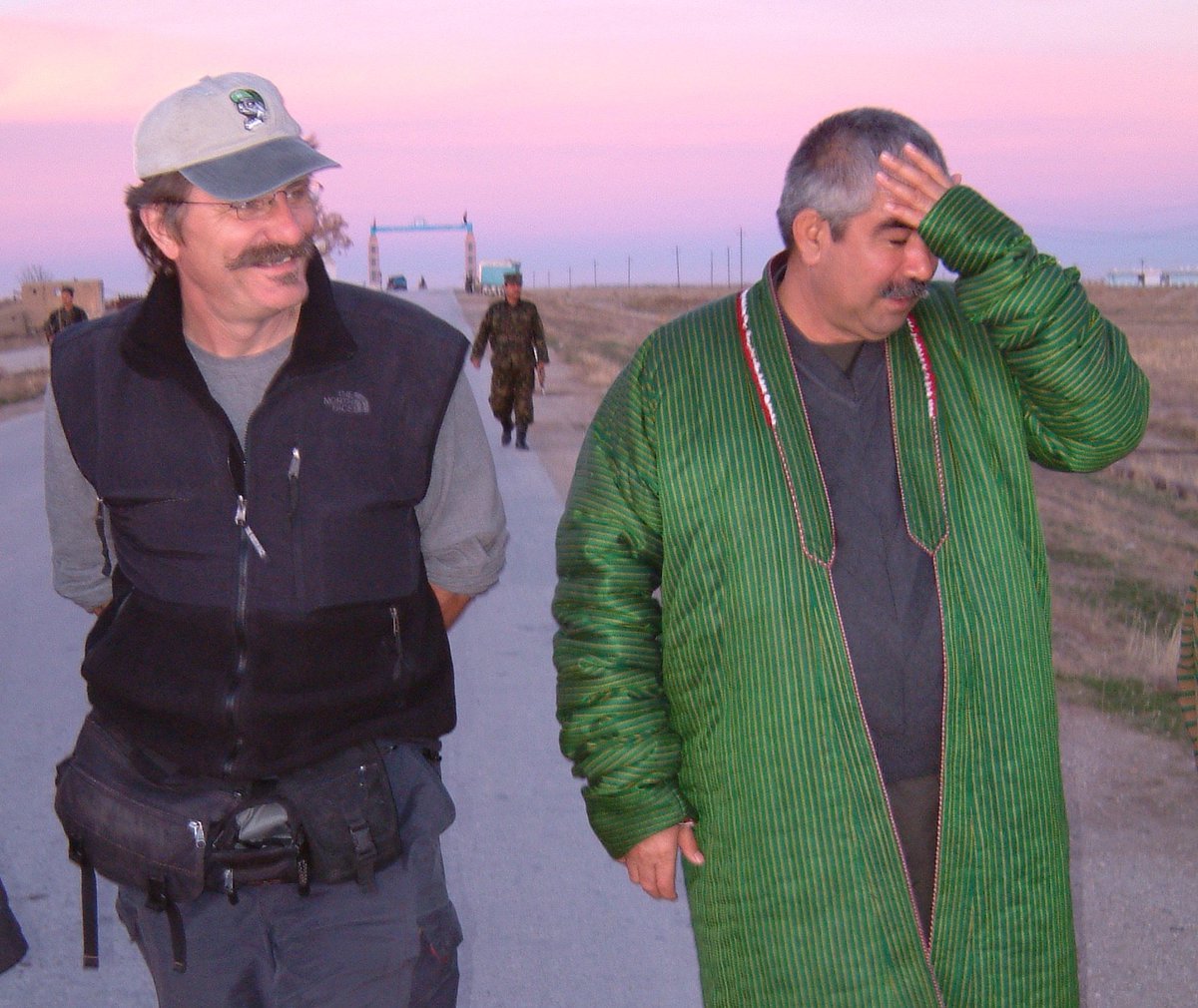
Robert Young Pelton and General Rashid Dostum in Sheberghan 2002 ©RYP, all rghts reserved
n a tiny, sparse room are his father, Dostum’s former teacher, and a village elder. The old men are frail, with deeply lined faces. The teacher giggles, his white beard shaking with joy. Dostum’s father talks to his son as though he were a child, telling him that he and the teacher have been praying for his success. They reach out to shake his hand, to embrace him. The men in the room try to act formally, but as Dostum starts to leave, some begin to cry. An old man yells, “God bless you. We are alive thanks to you.” As Dostum stands on the porch, looking at the place of his birth, he chokes up.
He takes me to the hilltop above the village. It’s a high, lonely place. When war first came to Afghanistan, two decades ago, he built his first stronghold here to guard the village. Dostum points to the fresh dirt of new graves in the cemetery. “The men who first defended this post with me are all dead now. The new graves belong to those who were fighting terrorists.” He is silhouetted against the slate-blue sky, the long tails of his silver turban whipping in the wind.
For a brief moment, the general stands triumphant, the conquering hero, the bring-er of peace, the warlord who has ended war in the north—and, therefore, perhaps eliminated his own reason for being. As he leans into the Afghan wind, the light falls, and a moment in history fades.
Dostum must now change his focus from fighting to rebuilding his country. (Within a week, he will be named deputy minister of defense for the new interim government of Afghanistan.) Now, on most mornings, Dostum emerges from his house, squinting into a crowd of turbaned men waiting for an audience. They sit patiently for hours, clutching tiny pieces of paper, seeking his aid. Dostum’s meetings do not end until well after midnight.
Not long before I’m to leave, Dostum asks for help with a letter of condolence to the widow of Mike Spann. The task inspires him to try to express his feelings about the past two months. He confesses that he had worried at first how the Americans would handle Afghan warfare: “It was cold; the food was bad. The bread we ate was half-mixed with dirt. I wondered if they could adapt to these circumstances. I have been to America and know the quality of life they enjoy. To my surprise, these men felt at home.”
And more than that: The Afghan warlord and his tiny band of American soldiers had clearly formed a bond that only men who have been through combat can understand. “I now have a friend named Mark,” Dostum says, referring to the Green Beret captain. “I feel he is my brother. He is so sincere; whenever I see him, I feel joy.” He pauses for a moment, lost in reflection. “I asked for a few Americans,” he says finally. “They brought with them the courage of a whole army.”
Down the road at the Regulators’ make-shift barracks, a call comes over the Motorola: “Pack your shit.” The men quickly gather their gear, as they have so many times before. Within hours, they are gone.
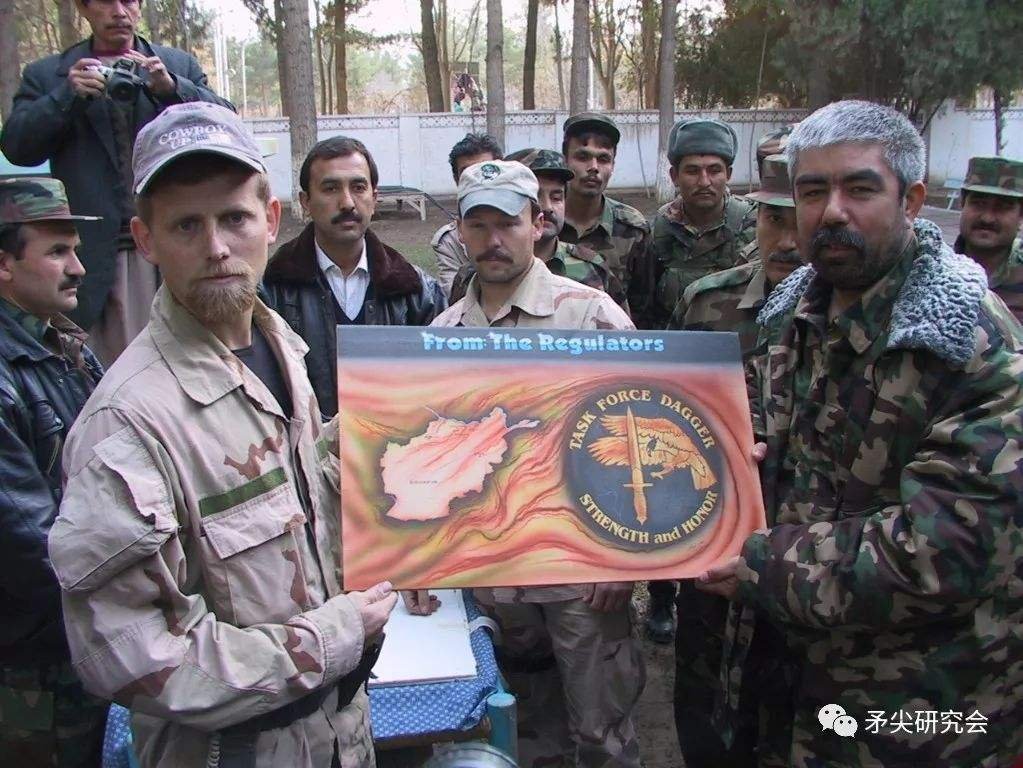
The ODA snuck back in to celebrate their victory with General Dostum. Captain Mark Nutsch and Steve suffered he effects of three hard weeks of constant moving and combat.
END
INSIDE BURMA’s Dirty war
Pelton is smuggled in to Burma and hikes three days across mountains to live in a remote rebel camp run by a former Green Beret officer. The camp is paradise on earth while the war ragainst the Junta rains hell down on the locals. Meet the Father of the White Monkey.
It’s a badge of honor to do illegal river crossing and the steep hike. But once inside a new world awaits.
THree days hard hiking inside Myanmar is a rebel camp run by a former Special Forces Colonel. Pelton could not resist.
Kawthoolie – The distant sound of steady mortar fire didn’t seem to bother Lt Col Nerdah. Nerdah is the 41-year-old commander of the 6th Brigade and the son of the late Karen supreme commander Bo Mya. The commander had changed out of his dress uniform and was now relaxing by candlelight wearing a black t-shirt and beret. Nerdah had just concluded a busy day of peace celebrations between the DKBA (the Myanmar government-backed Buddhist faction of the Karen) and the rebel Christian faction. But the day wasn’t over yet. “There are about 100 government soldiers making their way toward us. I will send my men to attack them and mine the way. It will not happen quickly.” Turning our attention to the dinner of rice and tinned sardines it seemed just like yet another day in the 60-year-old war between the Burmese government and the Karen rebels.
The Karen have been fighting their war of independence ever since the British gave national sovereignty to the Burmese after World War II. Like many other ethnic groups pitted against a brutal regime, the Karen view the Burmese as historic interlopers and brutal oppressors. The outside world sees the conflict as an endless internal war generating countless deaths and hundreds of thousands of displaced people. And while there are signs of progress — President re-elct Barack Obama and Secretary of State Hillary Clinton are slated to visit the country this month, which will be the first visit by an American President in more than 50 years — a recent report by the International Crisis Group reaffirms that Burma has long been on the brink of internal collapse and that, in reality, little has changed.
Today, the Burmese government and the generals control the central delta area while the ethnic groups surround them. The country is divided into black zones where free fire is allowed, brown zones where rebels are under control, and white areas where there is no fighting. My trip is to the black zone just east of the capital city, Yangon. The steep, remote area is made dangerously beautiful by limestone cliffs, lush valleys, dense jungle and unspoiled rivers, like the Salween.
It is here in the unrecognized nation of Kawthoolie (no one can quite agree on the source of the name) that the Karen rebels appear to be making their last stand against the ethnic cleansing, slow strangulation and constant attrition imposed by the Burmese generals and their 300,000-man conscript army.
I came to Burma during the elections. The first ones held in two decades. The rebels and minorities assumed the Generals would win and would use that win to launch a decisive offensive against the Karen. The United Nations and much of the Western world considered the elections rife with fraud. Not surprisingly, the State Peace and Development Council won handily. As a symbol of the party’s confidence, it released former democratic leader Aung Sun Syu Shi from house arrest. Although the event was noted around the world as a positive sign, it did nothing to help the millions of ethnic groups still fighting the government. If anything, her arrest rekindled the flame of resistance — releasing an elderly woman to a defunct party seemed to show that her cause was extinct. Some ethnic military groups, like Nerdah’s, moved against Burmese government forces after the election. The current result was the fighting that was coming our way.
To the outside world, it may have seemed that the war between the ethnic groups and the Burmese had grown stagnant — it was, after all, the longest running civil war in the world. Even the Lonely Planet guidebook and agreed that it was safe to visit Myanmar. Sylvester Stallone filmed the fourth installment of his Rambo franchise along the Salween River and raised some awareness of the area. But with higher-profile wars in Afghanistan and Iraq, it seemed the rebels were doomed to obscurity.
I first became interested in Burma when I heard that a friend of mine, who I encouraged to go to Burma in the first place, was hanging out with the rebels. But even more interesting to me was the long-standing relationship between mercenaries and the Karen rebels. In he 1980s I had heard about the frontlines of Burma at Soldier of Fortune conventions in Las Vegas. Eager doctors, loud braggarts and quiet vets talked about war there, and the wink-wink part was that if you wanted to wield a gun, camera or scalpel, adventure awaited you in Burma. Many viewed the fight as a holy war where the Buddhist-but-rather-odd gaggle of Generals were intent on wiping out Christian hill tribes.
The Generals seized power in 1962, creating the country’s longest running military dictatorship. In reality, though, the war between the Karen and Burmese had gone on for centuries. The Karen have long since been an agrarian hill people who have viewed the Burmese as aggressive interlopers. Though this interloping may date to the 9th century, it continues to this day as the Burmese slowly, methodically and brutally eliminate, integrate and intimidate the Karen and other ethnic groups into submission.
The most likely explanation for why the generals haven’t totally wiped out the Karen is the people’s inherent skills as classic jungle guerrilla fighters with a history that goes back to supporting the British against the Japanese, which led to the inability of the Burmese rulers to provide ethnic representation inside what is now Myanmar. It is clear from watching the non-government controlled areas shrink over time that the Karen are losing.
There is another reason war continues. War is a business in Burma. War keeps the Generals in power and the rebels fighting. The Generals of the State Peace and Development Council (SPDC), formerly known as the SLORC (State Law and Order Restoration Council), generate one 100 percent of the their foreign direct investment for natural resources (minerals, oil, teak). The international monetary fund estimates that the Generals have $5 billion in foreign currency reserves , and that they’re ‘working’ the disparity between the official exchange rate for natural gas at 6 kyat for every U.S dollar externally, but internally providing 1,000 kyat for every dollar — keeping the 994 kyat and dropping only kyat in the national bank. That neat trick earns Myanmar the label as the third most corrupt nation, according to Transparency International (only Afghanistan and Somalia are considered worse). There is also plenty of money for Russian fighter jets (20) and helicopters (50), Chinese light attack helos (50) and troops (300,000), and an embryonic nuclear program. The grim statistics firmly place Myanmar at the bottom end of the world’s list of countries.
The Karen National Union (KNU) and its military arm, The Karen National Liberation Army, have been fighting this war for 60 years, since the first post-colonial battle on January 31, 1949. The Karen, however, have not been not without the suspicion that the Karen leadership have also turned the war into a business that supports an aging Karen infrastructure. More war, more funds; no war, no funds. KNU leaders collect the donations and supplies and do not pass them down to the troops (who fight for free) or the villagers. The Generals keep a tight lid on coverage of circumstances in Burma, and the rebels, by virtue of their isolation, get little to no coverage of their fight.
It’s hard, perhaps intentionally impossible, to estimate the size of the Karen army. A rough guess is 8,000 soldiers and 2,000 militia groups with varying qualities of weapons and supplies. The free fire area in the south, where I’m headed, is divided into seven Brigades, each commanded by a different personality. The goal of the Karen is to force a federal system, but their motto of “no surrender” reflects a lifetime of distrust of an enemy who continues a scorched-earth policy, combined with a “four cuts” policy that continues to shrink territory, gain control, and integrate Karen through division. There was clearly only one way to find out
Rob, 39, is a friend from California and former toiler in the LED-lit trenches of the Hollywood special effects factories. He is animated, multidimensional, attention-deficit-disordered and, for once, at peace with his new life as a volunteer and local restaurant owner. We sit above the river overlooking a postcard scene of tropical beauty — a place used by Hollywood to film movies like Air America for its similarity to Vietnam in the 60’s. As he shows off his girlfriend’s ta tim deep fried fish specialty, he looks for a way to sum up his life and reasons for being here.
“I put digital pants on dead VC in Apocalypse Now Redux.” His air quotes create a humorous epitaph. He continues, “I was Charlese Theron’s driver… Her mom was hot… I was a cocaine dealer, a bouncer at a lesbian bar, former skate punk, worked a halibut boat out of Cook inlet, an editor on the Gotti show. I even edited Intervention. He pauses in that ADD style. “We cut out the parts where the guy was smoking crack out of a broken light bulb while another guy was blowing him.
“I was sitting in a cubicle working stupid hours… making $100,000 and spending $100,000. Getting fat, frustrated and heading toward 40.” He flips out another Marlboro Light from a pack adorned with a gruesome photo of a cancerous liver.
“I was poor, not white-trash poor but Southern California poor. Spent my life in shitty apartment complexes. My Dad was a rocket scientist. My mother was a hippie who divorced my father when I was five.” The waitress pours another LEO beer and drops ice in our glasses. “During my teens, I was a fatty, a stoner and kind of a lush. My mother took me to visit Uncle Carol, a former marine sniper. He would beat me when I visited him at his ranch. He would say, ‘You’re kind of a pussy kid.’ He was a cut-off-the-ears type of guy. He would bring me down to the bar, order a Miller Lite and tell me Vietnam sniper stories like: ‘The CIA paid me to shoot this VC colonel. I had to shoot through this hooker.’”
Rob shakes his head. “When he bought his ranch that was my Auschwitz. I had to kill gophers, dig holes… crazy stuff. He was just one of a series of fucked-up mentors.” Rob takes another drag and stubs out the cigarette. “But, hey… I love the crazy people and the crazy people love me.”
He’s well prepared for the trip into Burma. He’s done it 17 times now and has a cupboard full of gear. Hydrating salts, foot care, HEST knife, Becker patrol pack, short machete, local bug juice (“You’re done having kids right?”), and one wet outift, one dry, a pair of US-made jungle boots… and the look.
“Yeah I’m a little vain out there,” he says. “I’m rocking a Khmer headband, aviator glasses and a fedora on top. Straight out of a Michael Jackson video. Burma is a funny place. Kids have names like Hitler cause they dig the imagery.”
Rob has been here a year and slowly been accepted into the expat community of NGO’s and freelance foreign military advisers. The difference is that the military folks who come over for two weeks or so don’t fit in. They go directly from the airport into safe houses. Every square inch of white skin has to be covered up. It bothers Rob that a lot of them seem to be on holiday, drinking loudly and showing gory pictures at local bar. “The Thais are cool with the humanitarian stuff as long as it’s on the down low. But some of these military guys are just genetically programmed. I guess they way they carry themselves, haircuts, clothing.” This nameless town is just one of the gateways for mercenaries, missionaries and do-gooders who come to help the rebels.
But it is another foreigner in particular, an American, who most drew me here to Burma. He is perhaps the most influential and effective Westerner working behind enemy lines to help the rebels. He has acquired an almost legendary reputation. In these parts he is know simply as The Father of the White Monkey.
Getting inside is simple. Look at any map of South East Asia and you can cross almost anywhere along Burma’s hundreds of miles of unguarded border. I chose to sneak in with Rob, who has spent some time with the major players. To get there requires hours of driving mountainous mud roads to get to a major river, where you’re then hidden under a dirty tarp and ferried to any number of Karen refugee camps along the border. In an odd love-hate relationship between Thailand and Burma, both sides agree to pretend that if each sees nothing, there is nothing to report or even to crack down on. But if you mess up and get flagged, you could be responsible for shutting down the life supply for thousands of desperate refugees.
The refugee camps aren’t the grim, tent-like affairs that smell of human waste and suffering. Karen IDP camps are clean, orderly with self-appointed management, security, logistics, bamboo houses and spotless latrines. People smile and wave and food, blankets and mosquito nets appear without prompting. This is one of the Karin’s main problems. They are stubbornly cheerful and resourceful, even in the worst of times. It may be this collective power of optimism, selfless charity, and lure of lost causes that binds outsiders to them.
We’re inside. We sleep in a classroom used to teach young Karen medics. We have been trying for days to contact Thai Boon, the head of “Ranger 49,” on the sat phone. Thai Boon is the man that can send us inside to meet the Generals and the foreign fighters. That night when we go to Nanji’s store for our nightly can of warm Chang beer, we find him cross-legged on the split bamboo floor. My first thought is that he looks and talks exactly like Jackie Chan.
He invites us to sit down. He hasn’t bothered to turn on his sat phone in who knows how long. “Where did I go to school? Harvard!” He laughs. “No, I have a grade 4.” He laughs louder. Thai Boon,47, is the son of a KNU bigwig. He runs Ranger 49, named after the year the war started, though he doesn’t really have soldiers nor is he a Ranger. But he runs the foreigners in and coordinates training.
“He’s like the Hollywood agent of Kayin State. He schmoozes all the foreigners,” Rob explains. “He used to run a $30,000-a-year officers training school. It shut down last year when it ran out of money.”
Thai Boon has been called here to meet with the Generals. Heads of the 5th, 3rd, and 6th brigades are here. Although Karen state is separated into 7 “brigades,” the 4th fell in the rebels’ June 2009 offensive, and the 7th fell soon after.
Boon hears my pitch of wanting to go inside and says, “You will go to 3rd brigade!” While the villagers watch Mr. Bean and a Dennis Rodman movie, Boon lays out a map on the polished bamboo floor of the store and holds it down with Burmese cheroots. “Here is 3rd brigade. Here is Dawa.” He slides cheroots to mark the spots. He chuckles with glee “Ooooh, it’s another planet! The rest of the world goes forward in time, we go back 250 years. You will see!”
In the dim light he gets serious and looks up at us. “You can go. But don’t give up… Never give up. If you give up, a lot of problems. It’s an 18-kilometer hike at night. Very bad.” He jabs his palm upward to make is point. “Very steep!” He makes clawing motions. “First night you walk by night. Rest of time you walk by day. Then four more days during the daytime. You just carry water. Porters will carry your packs! OK?”
Rob and I are not gaunt tri-athletes. I am 6-4 and 240 pounds, and the last time I took a serious walk in the jungle was at gunpoint after being kidnapped in Colombia in 2002. Rob and I look at each other. How could we say no?
“Dawa” is the home of the legendary Free Burma Rangers, or FBR as they are called. To some, the FBR is an “up the river” paramilitary force run by a deeply Christian, former Special Forces Major who goes by the name The Father of the White Monkey. Others will tell you that the FBR’s secretive leader is the most effective foreigner working with the rebels deep inside Burma against the Generals. Thai Boon waves his hands. “Crazy Amish Christian relief people. It’s hard to tell where they begin and where FBR begin.” Boon and Rob are reticent about the “gullawa,” or white people, who are currently inside Burma. ”The normal tour is a two-week vacation or leave. I don’t really get into to what they do. Some of it is above my pay grade. I have heard stories,” says Boon.
The next morning we have visitors. Two thin Italians from Lake Garda who rebuild villages inside Burma for an NGO called Populi, and a young American who is clearly ex-military. They have walked three days from the interior to reach here. The American says he is “security.” It’s hard to imagine what one unarmed person could provide in the way of security, but he says he is along to determine enemy troop positions and navigate the humanitarians safely in and out. The Italians were going to travel further until they found out that a three-day hike takes five days. They turned around seven hours short of Dawa. Rob and I remember to factor this in. The Karen estimate travel time for themselves—not for heavy, lumbering gullawas. We decide that if we make it to Dawa, it will be an accomplishment.
Although the American is at first stand offish around his Italian clients, when they leave he becomes chatty. Jack, 27, is a former Marine Force Recon soldier with who tells me that most of his military records were redacted when he started doing spooky stuff in Colombia starting in 1998. “I read an article in Soldier of Fortune about fighting in Burma. I kept that article on what to take inside, and had it posted on the inside of my locker for years.”
Jack first connected to Burma through Karen expat, Robert Zan. Zan was a former commander in the Karen army who now lives in Minnesota and raises money for Karen in the US. Jack’s next step was to get in touch with Thomas Bleming, a Vietnam vet in his 60s who wrote a book about his brief time in Burma and what appears to be his conversion from self-described PTSD effected Vietnam Vet to journalist to mercenary.
“In my Google searches,” Jack says, “I would come across Thomas Bleming mouthing off. So I made contact with him. He spent the next three months trying to sell me his book. His book is basically a road map on how to get in. He invited me to meet him here.
“Tom had made a couple of previous trips. He also went to Honduras to see if he could get involved in that. Now he is trying to get something going along the border in Mexico. He tells people he has been in 25 conflict zones and hasn’t yet figured out how to make money. Tom even appointed himself as consul general.” Jack sums it up: “The Karen are easy on people who are a little bit crazy.”
Jack also sees himself transitioning from marine to trainer to mercenary. “I was in the military from 1995 to September 19, 2001. I have been shot twice, stabbed seven times with an ice pick and had 8 inches of my intestine removed. Toward the end of my time, I spent nine months in the brig. I went from private to sergeant to private.” He provides a quick but convincing recap of his time working with counter-drug, CIA and other groups in Latin America and Africa. “I worked as a shooting instructor at Front Sight near Pahrump, Nevada.”
He first came to the region in 2007 on an “O” English teaching visa. Now he has an anti-piracy business. “My new piracy thing is only a couple of months old, but I know where to get everything.” He says his company STORM or Strategic Tactical Reconnaissance Maritime, was inspired by a TV show called Shadow Warriors. “I used to have a website but I couldn’t afford to keep it up.” But he did find that a lot of people were interested and has had over 3000 business inquiries. “Out of those, 11 were potential candidates. Out of those, four actually came, and three have made multiple tours. I did have a couple of 16-year-olds pretend to be 18 years old.”
Jack also thinks there will be business from the US government. “DEA wants info, the US wants info, but they won’t leave the embassy. Even when they want to meet, they don’t want to go more than one subway stop from the embassy.” Although Jack is enthusiastic, it seems the US invests accordingly. “The DEA is eager to fund with Toughbooks, sat phones and BGANS. They have to check with higher ups. They might give me 2000 baht a month [about $65 USD].”
“They are worried about drugs, nukes, China and North Korea. There are a lot of Burmese who would sell that info. Manifests, large equipment on RoRo’s.” His stillborn maritime attempt seems to have attracted some interest. “I have a bunch of people coming from Afghanistan. Couple of British guys, mostly contractors who have money. All I have is contacts and experience. I don’t have any money.”
Jack sees a bigger geopolitical importance to the region. “China is setting up in Burma big time. Rich people in America want to disrupt shipping along the coast for the Chinese. We could set it up for $500,000.”
The ideas keep flowing as we chat inside the bamboo clinic. “I am thinking of doing anti-piracy along the coast. Charge fees for the ships that come in that steal the fish. The Burmese have no presence along the coast. I know I need two fast boats.” He finds humor in the idea. “We could charge them a fee for fishing in Karen waters.”
Jack’s newest idea seems the most far-fetched and most lethal. “I want to use an ultra light. Fly it out of a small strip… Ultra lights can carry 250 pounds…You can arm them. I put an M16 on an ultra light with a scope and night vision. You shoot from 6000 feet… the bullet goes straight down… We tested in out in the desert near Fresno. We laid out a bunch of soccer balls, something the size of a human head… Start at 16,000 feet and glide in. It takes about three shots during the day. At night it takes longer, six to seven shots with night vision.
“You can buy them for 16,000 bucks. It seats two side-by-side, or pilot and load.” Jack is full of ideas. “I can get Glocks for 45,000 baht ($1,500 USD). I can get M1s for 25,000 baht ($830) all day long. I can get all the ammo I want. But I am broke. I am about as broke as they come.” His clients call. Time to cross the river.
Late at night, Rob and I are sitting on a rough-hewn bamboo bench listening to the sounds of the jungle at night. The creek burbles, people inside their huts are singing and the usual group is watching a Mr. Bean DVD on the battery powered TV for the umpteenth time and laughing at the exact same spots every time its played. The stars burn through, and we stare up. Rob talks about death. “I had thyroid cancer. They took it out. Had a Cambodian kid in Seattle die in my arms after he was shot in a drive-by. Found a dead homeless guy that was stabbed. Those things seem to gravitate to me.” A satellite tracks across the sky as we sit in the cool of the dark. “My girlfriend shot herself. When I was 22. We broke up. She went out and bought a Remington 303. She called my friend, ‘Is Rob there?’ And then shot herself. I had to go pack and clean up her place. I found pieces of skull and brain in my clothes. I kept going in a downward spiral. Like a tuna before you gaffe it.” He doesn’t have a funny ending. He pauses. “Eighteen months I was working in a cubicle. Now I am here.” A shooting star interrupts him.
“Look at those people.” He nods to the Karen watching TV. “There is a soldier, sitting next to a baby. Look at the women. They are smiling”. He pauses again but there is no shooting star that burns and disappears. “I am happy here.“
The next morning we are on. Thai Boon has set up a meeting with the generals. We travel to the “commando training camp” before dawn, and the first thing we hear is the raucous sound of two distinctly Americans voices bellowing, “Fucking… fucker… Fucking …dipshit. Fucking… goddamn… fucking… asshole…”
As we hike up from the river there are two geriatric silver-haired men drinking their morning coffee discussing old times and acquaintances with a liberal dose of profanity. They are here to train General Bo Jo’s Special Forces. They are both Vietnam-era Special Forces vets, one with time in Germany and Cambodia and now training contractors in the US.
A few yards away a fire is cooking two pots and what looks like a very large vine. On closer inspection, it’s a freshly killed python. The Karen eagerly drag the 8-foot snake across the coals to cook their morning delicacy. While the two Americans continue their good spirited but foul-mouthed conversation, I talk to 48-year-old General Bo Jo, the commander of the 5th Brigade—the most active and largest of the KNLA army. The 5th Brigade has about 1,300 men under arms, and is up against about 3,000 Burmese troops.
General Bo Jo’s grandfather worked with the legendary “Grandfather Long Legs” and spent time in prison with him. He began as a Sergeant in 1982 and has been a General since 1997. Like many senior Karen, he has a link to America. His wife is in Indiana working on her PhD. He is not optimistic for the future. He sees the struggle lasting another five to 15 years. He personally visits each village that is burned, and he asks me if I have any idea for a better freedom for his people.
As the interview wraps up the General says to me, “Don’t forget about us.”
After the interview Bo Jo puts on his uniform for photos. He wants to just sit and talk with us. Behind us the python is being served up, two small dogs fight and the cook puts on a large pot of boiling water. Mama noodles, bamboo shoots, fried potatoes, sardines and rice. All washed down with Birdie premixed coffee. By now the two silver-haired Americans begin teaching their classes. Down by the river they have built a small model of a Burmese Army Base. With the aid of an interpreter one of them is teaching the Karen how to attack: “The snipers need to take out the towers, while the rest of the forces fires mortars” The other hobbles off into the jungle with the aid of a cane to start the class on self-defense. A British instructor is working on training the Karen in the use of a shortwave radio.
A lot of gear is donated to the Karen effort, and it gear ranges from erasable markers to motorcycle batteries to soldering and wiring kits. Communications equipment is their most important need. A quick inspection of the Karen Special Forces soldiers is not encouraging. Their weapons are battered Vietnam-era Colt AR-15s, some still stamped “Property of the U.S. Government.” Some carry bolt-action rifles and Garands that date back to Korea and World War II. They have rubberized jungle packs and most wear sandals or flip-flops. A few have jungle boots. Some commanders wear tactical leave-behinds by foreign advisors, like Casio watches, binoculars and the most popular gift: telescopic rifle scopes. Before we leave, General Bo Jo asks to have his picture taken with me and to get an autograph. “You are our advisor now”.
After almost a week of waiting, it’s time for our march into the heart of the conflict. We take a boat upriver for an hour. Hidden under a stifling black tarp is a doctor, a former electrician and now pastor of a church in Southern California, the wife of a former SF soldier, the wife of a volunteer, , another doctor, a former missionary pilot and head of partners, and a silent American who turns out to be a property tax accountant on vacation with the pastor. We are dumped off on the riverbank as the last light of day disappears. Inside the jungle, it is even darker. We switch on our headlamps for the long walk ahead.
It’s easy to both embellish and understate the amount of pain and effort it takes to hump a heavy pack up and down guerilla mountain jungle trails. The best way to describe is to say that one very physically fit and young man would attempt this walk and fail. The doctor along with us has also tried and failed this hike. The distance is only about 20 miles, but the terrain is chosen specifically to deter Burmese army troops. On painkillers and only ten feet at a time, we accomplished the hike. Large holes in the bush were reminders of where sure-footed pack mules slipped off the muddy trails and crashed down the side of the mountain.
On the tail end of the second day we hiked down from a mountain, sun baked, thirsty and in pain and ended up in Dawa. There to meet us was the Father of the White Monkey. We’ll call him Doug. Doug was a former Ranger, Special Forces Major and always a devout Christian. He immediately greeted our small group by praying and then loading up our packs for the hike deep in the forest. After a bamboo-raft river crossing, a steep hike up and down, we arrived in a narrow valley. Camp Taw Wah, one of a number of training camps used by the Free Burma Rangers to mentor and graduate five-man teams that spread out across Burma.
This camp is in a deep, green valley with a spectacular, boulder-strewn river at the bottom. There are a dozen huts—woven grass roofs, pole supports and made from peeled bamboo. During the day, purple and black butterflies flit in and out, cicadas chorus. The ground is river silt with the tops of giant boulders poking out and bamboo sprays. It’s the start of the dry season. At night the frogs call to each other like ducks, the stars explode and the cold air rushes down. Nights are chilly as the moon slides over the narrow valley with only the sound of people talking softly.
At 5:30 in the dark morning, the sounds of PT enliven the camp. Doug leads the exercises in singsong Karen. Before breakfast the recruits chant an English statement for freedom before digging in to massive bowls of rice.
The camp is small and the small bamboo huts holds about 100 young men and women. There are three Americans, two of them ex-military, one a computer expert. There is also Doug’s family of three young children and his wife. The two Americans, volunteer military trainers, are joined by their wives who were along for the hike. The gullawas eat at a headmaster’s table elevated above the recruits’ area. Anyone who has been to a military or boarding school would recognize the concept immediately.
Doug is up before dawn reading his bible or books and has run up the mountain and back before six o’clock. The Father of The White Monkey is a dynamo of energy and optimism: tapping out emails on his ToughBook, talking on his solar-powered sat phone system, meeting with recruits, writing update emails or making lists on the many white boards. He is a hyperactive perpetual-motion machine. But he often stops mid thought or sentence to ask people to help him pray. It’s hard at first to understand why a well-trained military commander would stop and seek guidance and support. The concept took me back to my days with al Qaeda and other jihadi groups. Like the Chechen rebels, also trained in the military, who simply said, “Our faith in God is simple. There is no one else to help us”
Doug has no one to help him other than the few medical and military volunteers who risk the steep trails and hard living, the young Karen, who put in 4 months of training, and his religion. Deep behind enemy lines—his only supply chain by foot or mule—he has managed to carve out a well-oiled training camp, high tech communications center and beacon of hope for the Karen. Doug is thin, small shouldered and wiry but his accomplishments are immense. The students beam under pressure and constantly say; “Rangers never give up.”
I ask Doug why he calls his operation “Free Burma Rangers.” Like many of Doug’s decisions, it is intuitive and simple. “I made up the name when I climbed Mt. McKinley, and I had to write down a name. Kind of like the Texas Rangers or the Army Rangers.” He started in 1997 with one local media team and now trains five- man teams from volunteers. They are trained in security, communications, media, medical skills and morale. But Doug makes the point that this is being done by the Karen, not him. Koala Bear, a small, hard-as-rock 37-year-old Karen commander, is in charge of training.
Doug has the unnerving habit of interrupting our interview with a prayer. “Robert, what kind of Christian are you? I need some prayer.” I don’t know what to say after seeing the godless wastelands of insurgency and terror in 36 wars. Without an answer, he prays for my success and the Karen. Then just as quickly pops back into interview mode. The Free Burma Rangers now have 15 different teams, and do two-month missions to document and help Karen that are attacked by the Burmese army. Volunteers spend four years inside FBR and then move on to military, support or political arms of the KNU. Currently he has 11 different ethnic groups at the camp, and even one Muslim. Doug estimates FBR burns through about $1 million a year, mostly donated from church groups. “We have 55 teams out there, but we are treading water. Help, hope and love is how they survive. We do our best to send out information, to help the people, stay with the people.” Looking to define it better, he then adds, “I cannot run away.”
Although Doug is a devout Christian, who grew up in Thailand and whose parents are Baptist missionaries, he insists that no one is trying to change anyone’s religion here—though there is a distinct sense of religious zeal and devotion in the camps by both instructors and students. “We have been here seven years, have four other training sites and eight teams operating from the Indian side. Since I was five years old, I wanted to be a soldier and then missionary.” His dad was a missionary when Thailand was still rural and undeveloped. Dave was sent to a boarding school at age seven. “That’s when I gave my life to Jesus. I got dengue. I was crying under my pillow. I was alone and sick I asked Jesus to help. And I felt this warm love come over me.” Growing up in Thailand shaped him. He used to hunt, fish, hike and ride horses while his missionary father dug wells and built schools. This beautiful mountain landscape with raw rivers and pristine hills is also his home. He owns 150 acres and wants it to be a national park. He bought it for $1,500 after the owner’s elephant trampled the rice crop when he was a way.
Doug’s history is both religious and military. He joined the Army, then wanted more of a challenge so he went to Ranger school. Because of his Thai language skills, he then became Special Forces. “In 1992 at my ten-year point I could have gone CAG (Delta Force) or Defense Attaché but got married. I met a lady and she left me. We were both immature, selfish people.” Doug’s life seems to be a constant battle between success and failure.
We talk about the conflict of religion and military life. He tells me a story. “Robert, when I was 27 years old and I was a Ranger, we were preparing to overthrow the dictator in Surinam. My job was to take out a group of Cubans at Paramaribo Airport. Bad dudes. To get to them we were going to have to run a mile and a half with full gear and then call in coordinates for an air strike. I was supposed to give them a minute to surrender before calling it in. But good old Ranger Lieutenant Eubanks was going to run in and just let them have it. The operation never happened but later my commander, General Mayer heard this and said, “You were going to give them one minute weren’t you.” Doug was surprised that Eubanks had no problem killing dozens of people without hesitation. He said, “You may be in the army but you serve a higher force. I thanked Mayer. That’s when I learned that I serve something higher.”
The higher force, despite the military structure, has kept FBR funded by humanitarians, church groups and individuals. One day, instead of the normal PT that keeps them lean, they are practicing singing songs, throwing Frisbees and making each other laugh—a task to cheer up demoralized and abused villagers. Their weapons are whatever the students can beg, borrow, buy or scrounge. I saw less than a dozen very old M1s and AR 15s in the camp.
The other odd part of Doug’s life is that his wife, his two young daughters and son live with him. “We want to be together as a family. The locals asked us to bring our family. It shows them that here it is safe. There are no locks on the door here. The Karen break a candy bar and break it into five pieces. We have two days warning if the Burmese are on the move.” He is proud that his son Peter did a 30-mile movement at age four. I ask him about the new attack helicopters. He says he doesn’t think it will be a problem and then says, “Yeah, we should probably think about digging bunkers.”
He said he was first mobilized to do something when he met the leader of the democratic party. “I met Aung Sang Syu Khi in the States in 1996. Even though she is a Buddhist, I gave her a bible and asked if I could pray for her. She said we need the prayers of people. I said I would be obedient until death. Just like the Lord says. Be obedient till death… So I am obedient until death.”
Doug has to balance life between being a mercenary, missionary and humanitarian. He makes it clear that no one here is making money, removing the mercenary stigma. He admits that there are plenty of foreigners behind enemy lines and the main sponsors do their best to coordinate. But he defends the need for military people in this war. “When the fighting starts, the missionaries all leave, the NGOs are next…but where are the Livingstone’s? We stay with the people under attack and will not leave them. We have no program of arming teams. We also prohibit offensive action. There is always room for people’s interpretation. It’s not a clear black and white.” Then he finishes by saying, “I love this God who speaks through the voice of God.”
“I don’t know what we are going to do next,” he says. “All I know is that I have 13 years of doing this. I have been in five close firefights… I like to fight, but God has never told us to do that. We have lost eight guys, half by sickness and half by combat.” The best perspective is the most banal, “Really the biggest danger is blisters, whacking your head or malaria.”
Doug and the FBR teams are the best single source of intelligence coming out of Burma. Thanks to his teams, the tactics of the Burmese Army are well documented and distributed via his website. “The SPDC mortars the village, chase them away, shoot and loot, then burn it and leave. The idea is to drive them into camps in Thailand or surrender. They kill the rest.” He has books of photos of murdered, raped and abused villagers. Once singular event that haunts him is a seven-year-old girl, raped, shot at point blank range and left on the trail for the Rangers to find her.
I ask Doug where God was on that day. He immediately asks. “Can I pray, Robert?” His eyes clench, he lowers his head and he prays out loud for the “strength and guidance to carry on”. He looks up at me “When you experience something like that, you want to kill them all, eat their bodies and then eat their shit and piss so there is no trace of them…. But the four of us [the FBR leaders] voted on it and said, no… we will be with the people and defend them.”
Doug wants me to understand we’re in an active war zone. “Burma is divided into 10% free fire or black zones, 20% brown or army controlled and 60% peaceful. We are in a black zone. We can recon the army within two hours. But you saw from those trails, that they don’t come here. The Burmese army doesn’t want to burn villages and murder villagers, but they are forced to. We intercept radio communications where a the major said if you want to be promoted you will burn the village if you don’t you will stay on the river.”
Part of fighting back is not only documenting the methodical human rights violations but also staying alive to do it. He views his position as a mouse between two elephants. “In 1997, the two governments of Myanmar and Thailand had meetings. The Burmese said these Special Forces guys were causing problems. Within an hour of the Burmese leader landing, the Thaïs arrested us. Thankfully, we were released. This Thai General said I fought for your release but God got you out. I believe in God. I don’t go for a hike and throw away my compass but God guides me. So we have a working relationship. They say don’t mention your name and never show your face in a publication and cover up all the white people who enter.” For some reason they don’t care about Christian publications. One group in the government supports his work because he keeps the Karen refugees inside Burma, the other group wants to shut him down and a third group doesn’t care either way. Today FBR is 250 people. I push him on what he really wants. He says “300 rifles?” He smiles. Doug realizes he must walk that line again. “We have zero secrets. No secret spook stuff, but if the CIA wanted to help us we would take it.
Later that day, one of the American military trainers is concerned that the story is about the “ethnics” and not “the white faces.” He was trained as a Marine Sniper and his wife is a midwife. “She was trained to bring people into this world and I was trained to take them out.” But I ask him why he is here. “There are only so many conflicts that are this right. We are only here to support them.”
At dinner, we talk again. Doug is still trying to get to the core of his motivation and his constant internal battle. “Injustice is someone who holds you down who is stronger. I am only 150 pounds, but how many times have I been unjust?”
Dave constantly asks me to focus on the Karen and not on the gullawa. But it is clear that the outside support is one of the reasons why the Karen have held out so long. Villagers, dirty, tired and smelling of smoke and urine, sit patiently for the FBR medics to take care of them. It is up the western doctors to operate on a small boy, draining the pus out of his knee. The two doctors set up a makeshift operating area across from my mat and cut in without anesthetic.
Doug’s opinion of the foreigners is that unless they stay, fight and actually are there throughout the combat operations with the Karen they trained, they are just here on vacation. He also thinks that the Rambo-like mentality of many of volunteers, like the Americans who were detonating large explosive charges right on the border simply makes it more difficult.
“The history of outside involvement probably began with Captain Hang, who was a veteran of the French-Indochina war. He was a legionnaire, Vietnamese and rose in France. He not only trained but he went and did the operations. Very tight. When I see some of Bo Jo’s men operating on the river, I can see Hang trained them.
“A couple of more Legionnaires came in the French marines. They did well. By the fall of Mannerplaw in 1995, the easy access was gone. There were very few foreigners in here after that. Lots of fighting, travel was dangerous, nobody knew who to talk to. Before July of 2003 they were just across the river at Mai Salit under the cliffs, but the Thais told them to move or they would have to arrest them. You could come in a wheelchair. Wouldn’t even get your feet wet.” He points to the sheer green walls around us. “Now you have to walk.”
After a couple of weeks come and go, the pain from the walk has vanished. I am losing weight, eager to run up hills. I bathe every day in a jungle stream, eat rice and deer meat, go to bed at 8 p.m. and get into the rhythms of the jungle. The young men and women of the FBR have become friends and invite me to take part in their activities. It is clear that for someone looking for a cause, this place is like Mecca.
Before we leave the students surprise Rob and I. They hoist us above their heads, cover us in ash and dirt and then throw us in the river. Then they carefully wash us off, smiling and laughing at this simple ritual of acceptance. I suppose it’s a baptism of sorts. There are long speeches from both sides, crudely printed diplomas and earnest thank-yous, and then it is off to the green vertical hell for two days of walking back to civilization. But this time, it’s enjoyable and I’m a little wistful.
Nerdah Mya is probably the most famous Karen commander. Before I interviewed General Bo Jo and the other generals, they had not been interviewed by Western reporters for five years. Nerdah, by contrast, posted a YouTube interview a few weeks before our arrival. He can be seen and read about in dozens of publications or documentaries. I am intrigued and want to meet the most famous Karen rebel commander—the magnet for much of the controversy. Rob says back at his restaurant, “If Nerdah has any foreigners there, he will trot them out like it was the Westminster Dog show.” After a few phone calls we are directed to drive south and meet with “Gary.”
Gary meets us at 4:45 a.m. outside of his hotel. He is short, heavy eye browed, bullet headed and speaks in a broad Australian twang. We quickly learn he has an obsessive love of providing painfully accurate directions even to the gas station. I figure Gary for a security contractor on leave from Iraq.
We meet a film crew that is also going in. A disheveled Frenchman appears out of a van and keeps asking us who we are. A former French marine turned fixer and photojournalist, he is there to make sure the BBC get in and out without a hitch. In our conversations with Nerdah’s people we had arranged to go in, and we’d been told there might be an ABC or BBC crew along as well. “Nerdah thinks everyone is the BBC,” quips Rob. It turns out it actually is the BBC crew here to cover a historic event.
Unlike our death march to visit the FBR, Nerdah’s soldiers simply drive down a rutted road between huge limestone spires, and suddenly we are in Burma. At the checkpoint a thin fair-haired, middle-aged westerner in military garb stares intently at us. We are in a hurry not because there is fighting but because there is a peace ceremony between the DKBA and KNU. We arrive just as two lines of armed Karen fighters shake and hug.
The rest of the sweltering day is filled with droning speeches, except for a speech by an elderly monk, Rambo. The constant waves of laughter help him work the crowd like a Karen Rodney Dangerfield. Rambo is famous for showing a few Karen rebels how to hitch a ride: They stood beside a road trying unsuccessfully to flag down a driver when Rambo borrowed their gun fired a few shots at passing cars until one stopped. He then handed the gun back, and said, “That’s how you stop a car.”
Nerdah makes a speech first in Karen and then in English for the benefit of the BBC. On the tail end of election coverage he has brokered the Buddhist Karen troops switching sides from the Myanmar government to join with the Christian Karen. They shake hands again for the benefit of the BBC crew and the few unshaven stringers. “Today is the reunification of the country,” he says. “The Burmese will respect our freedom.”
Troops from both sides wear garlands of flowers and on command hug and shake hands. A Buddhist monk blesses then and a priest officiates. Children sing as speeches are made. Colonel Nerdah greets us and welcomes us. A new DKBA flag flies next to the tattered KNLA flag above Krep Po Ta village.
As Nerdah poses for pictures, he greets me in very slightly accented American English. “We must psyop them. After the election we must take the initiative. The Burmese army is waging psychological warfare against us so we need to show that we are together. Aung Sung Syu Kyi cannot do it by herself. We need to forgive and forget. We show love and forgiveness.”
That night back at the camp we have dinner. What made this candle light conversation unnerving was not the thump, thump, thump of distant mortars or even the mix of legless veterans and childlike soldiers that huddled around us, it was the constant smile and politeness of our host. This is ground zero for much of the interest by foreigners fighting inside Burma.
Nerdah was the mentor to Thomas Bleming and many other Western volunteers turned mercenaries. The reason becomes abundantly clear. Nerdah despite his high rank is one of us. A favored son of the Karen’s most famous commander who spent years in the US.
Nerdah went to school in the Napa valley area of California and even has a pilot’s license. He too has dreams of an air force, more volunteers, basically anything to push back the relentless murder and pressure of the Burmese Generals. But his ideas are likely to remain dreams. He shows me his village—once burned and now rebuilt by Populi—and urges me to come back anytime. The BBC is done and is on the phone looking for “abused refugees” from the recent fighting to complete their story. They finally have to film them backlit. Its time for Rob and I to leave the war zone and return to “civilization” a short drive back.
When we are done with Nerdah he appears in civilian clothes and is eager to get home to his three daughters and wife. Military commander has become urban commuter.
We are back at Rob’s restaurant in the small bucolic town. As the customers move inside from the rain, Rob and I have gin and tonics over a spectacular pad Thai. Rob is careful on how he lays out the way things work and the people that flow through here.
The towns along the border are full of NGO workers with ponytails and earrings. Very few go “inside.” Fewer take up arms. One man who did is Oregonian, Robert Erhausen. It’s opening night at his new pizza place on the river. He has a couple of tables. He stops making pies long enough to sit and talk. When I point out the sparse attendance he says, “It’s Ok. This place will make money. It’s a soft opening.”
Erhausen is the grandfather of the foreign clique. And runs the Displaced Persons Action Committee, supports the Safe Haven Orphanage, and now trains and supports seven demining teams who work with wands to clear mines. He doesn’t look 63 years old, but he joined the US Marine Corps at age17 and fought in Vietnam, working with the Nung tribesmen in the Central Highlands.
“I first came here off and on 14 years ago,” he says. Like many of the foreign volunteers, he came through Nerdah and eventually decided to stay. Rob was once connected to Baptist groups and ended up commanding a division of Karin soldiers. “I took over Ben Shipley’s old regiment. Ben was never in the military. He was doing drugs and went nuts. Started firing an AK and was shipped when the 7th brigade was overrun.”
Erhausen clashes with Doug because he now works with the government-backed Buddhist DKBW as well as the Christian KNLA. Erhausen’s take is that Doug is good on tactics but he’s not good on strategy. He applies that criticism to the KNLA. “It’s a business for the Generals. On both sides. They even give back weapons when they take ground from the government,” he says. He eventually ended up training General Bo Jo’s Special Forces but he senses that this war will not end well.“ I went to a meeting with the Generals and said, ‘It looks like you are losing a lot of real estate. What happens when you lose?’ They said, ‘we will pray.’” He shakes his head. “They are like the North American Indians at the end of the West. They’ll just take up the Ghost Dance . The Karen Generals are waiting for the second coming.”
He is getting less idealistic and more pragmatic. Even the pizza parlor is a better way to fund his activities. “If it weren’t for us they would have no medicine or food inside. I have fed up to 10,000 people.” Erhausen is interrupted by the waitress—there are more pizzas up.
I ask him about the foreigners. “A lot of people go home after a couple of years because they get disgusted.” He thinks back, trying to help yet another reporter with a story on mercenaries. “There were the Germans who paid to shoot people.” He offers but then thinks, “But it’s not something worth talking about.”
A briefing document shows that the end may be sooner than the second coming. The Burmese Generals have been eager students of how Sri Lanka successfully ended its 26-year-old war. They simply kept the media out and crushed the Tamils with overwhelming force. The Burmese now have built three-dozen new military bases, ploughed new roads and purchased 62 assault helicopters in preparation for what may be the final battle. The election was simply one item on a checklist to show that the “free and democratic” nation of Myanmar was simply eliminating a troubling insurgency. A campaign of infiltration, assassination, assault and assimilation is expected to begin this year. At that point, the war will be over. The foreigners have lit up the war in Burma, but one by one they flicker and then go out.
Waking back from Erhuasen’s, Rob seems to have forgiven Tookie, his girlfriend. When we returned from the jungle he was furious that a giant karaoke machine had appeared in his restaurant and that none of his hired help could find cigarettes.
It is the festival of loy krathong, and it occurs on the night of the full moon. Thais launch their krathongs to carry their dreams and to float away their sorrows. Others release khom fai, paper kites, lifted into the sky by a burning wick. The luminescent balloons float ill fortune away. Rob and Tookie light a flickering balloon and wait for it to rise. It gently sways and then lifts. It climbs until it is just a speck, then catches fire, and flares brightly. Then it is gone.
END
KILLING ISIS
Robert Young Pelton heads to Libya and enters America’s secret war on ISIS.
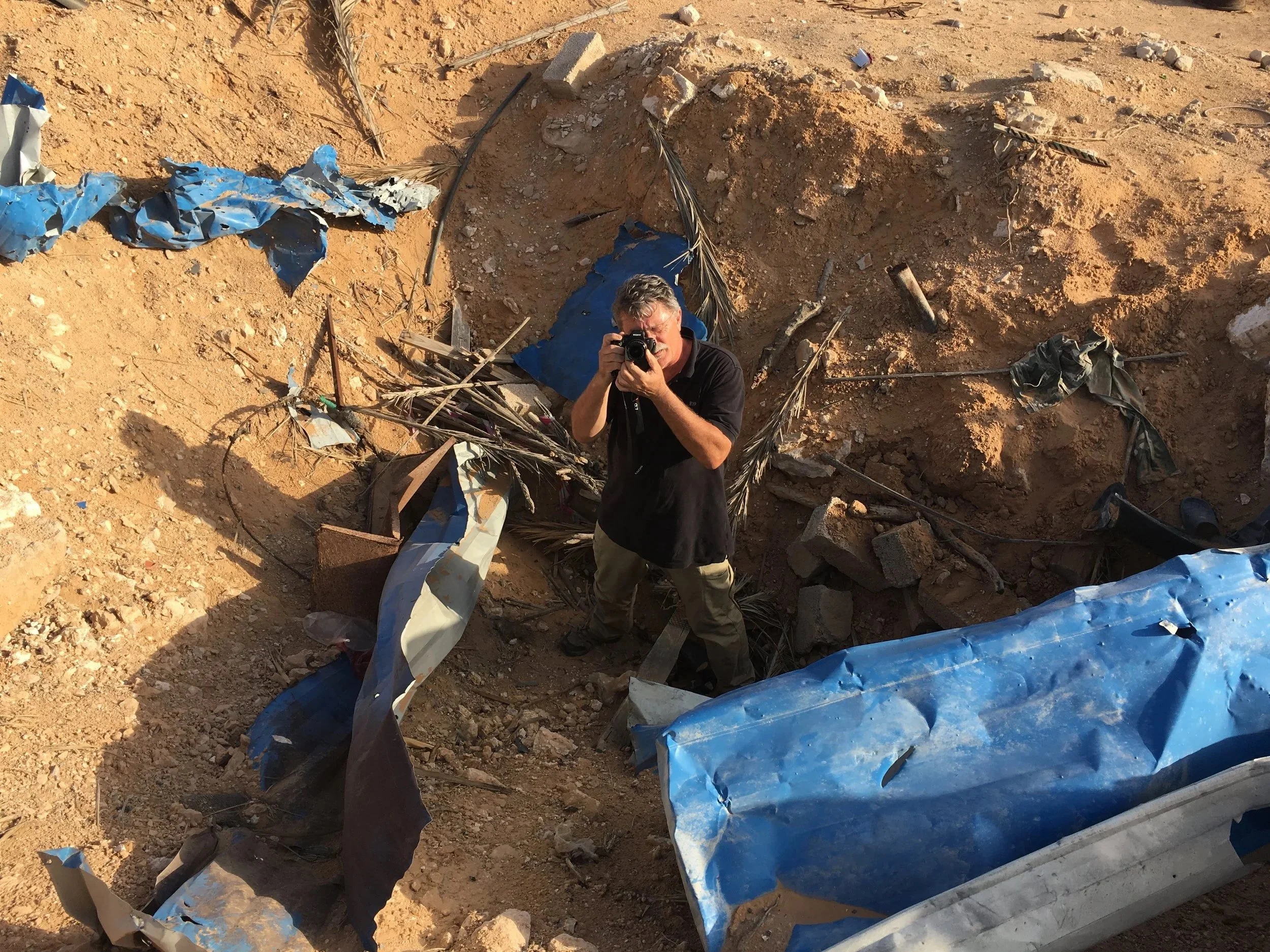
A recently bombed ISIS training camp is just on the outskirts of Sabratha. A flaming hoop and some ISIS memorabilia probably won’t make it back through customs.
Pelton gets a front row seat in LIBYA to understand AMERICA’s lATEST war on TERROR
At first, America tried to ignore ISIS. An Iraqi outgrowth of al Qaeda, it started in 2004 when escaped prisoners from Camp Bucca formed the Sunni group that became the Islamic State. It metastasized into Syria in 2013. By August 2014, American journalists James Foley and Steven Sotloff, both ex-Rangers, were brutally decapitated by ISIS in Raqqa. It didn’t help that over 40,000 Christian Yazidis were trapped on a waterless hilltop, begging the world for help.
President Obama looked at his options to eliminate ISIS. The 2011 idea of training “moderate rebels” in secret bases in Jordan, under a program called Timber Sycamore, had been a disaster. A trainer explained that from the intake of thousands of Syrians and Jordanians, they fielded less than 20, “And that was more like a dozen.” Most of whom were quickly compromised or joined better-armed Islamic militias. Weapons shipped en masse by Gulf nations, destined to support anti-Assad groups, ended up in the hands of terrorists.
In January 2014, hard-won cities like Fallujah and Ramadi fell to the Islamic State, and in June 2014, Mosul and the oil-refining town of Baiji fell as well. The Islamic State was on the verge of establishing a caliphate across Iraq and Syria.
Training and arming moderate rebels had failed miserably; there had to be another way. Why not repeat the post-9/11 scenario? Link Green Berets with local militias and bring in overwhelming air power to pulverize the enemy. In 2014, another plan was hatched; “Nine Dot Three,” a covert action group that linked the CIA, CAG, Special Forces, and the Air Force, based in Qatar. A secret program that only emerged when the team suffered casualties, including the IED that killed CAG operator Master Sgt. Jonathan J. Dunbar and British SAS trooper Sgt. Matt Tonroe.
ISIS had been created by Sunnis angry at the Shia and Iranian control of the Iraqi government. Funded by Iraqi Sunni tribes who controlled trade and by Saudis, Qataris, Emiratis, and Gulf millionaires, they had used violence and terror to quickly work their way up the Tigris and Euphrates rivers. By August 2014, their caliphate was headquartered in Raqqa, and the violent group began creating some of the most gruesome execution videos in recent history.
Obama handed over the mission to special operations. They quickly conducted a 14-day recce and set up safe houses and operational centers. CAG, also known as Task Force, coordinated with the CIA and Green Berets and arrived on scene to train the YPG, the Syrian Kurdish group that was immune to ISIS infiltration.
Al Uideed Air Base in Qatar was quickly ramped up to handle a massive air campaign that included coordinating everything from Reaper drones to B-52s. By 2015, there were 10,000 Americans on the sweltering air base 35 clicks south of Doha. By April 2016, the base was the center for killing ISIS. All they needed were eyes on the ground.
The early fight against ISIS was aided by the Task Force’s familiarity with the area. Many had operated in Iraq, Kurdistan, and around Mosul in the Sunni Triangle, where Saddam’s Anbari supporters held sway. In addition to a large ground network of informants and spies, they had the infrastructure America had built on their side. The problem was where to start. The CARVER Matrix was a big part of choosing where to strike first. The simple 6-column by 5-row chart uses Criticality, Accessibility, Recuperability, Vulnerability, Effect, and Recognizability. Once the operator jots down the numbers based solely on his perception of the battlefield, choices are made.
Civilian casualties were a concern. ISIS used civilians as human shields, hoping it would turn the population against the West. Operators were smarter than that. They went after the banks, a brilliant move that drained hundreds of millions of dollars from ISIS coffers. They would be hit at night. “I wanted enough to leave rubble; the Air Force delivered enough to leave dust,” one insider remembers. Cyber warfare and high-tech weapons played a big part. The Reaper was in plentiful supply; sometimes half a dozen were available for persistent surveillance on targets. The 66-foot aircraft could be outfitted with a variety of weapons that could be laser-designated or locked onto targets using GPS coordinates within 5 meters.
CAG is normally known for door-kicking and anti-terrorism involving civilians. Now they would become targeteers. Working out of the LaFarge cement factory in al Raqqa province and linking up with local ground networks to identify, confirm, and destroy ISIS assets and personnel in a withering air campaign. Only one direct action operation took place against a prison. Manned and unmanned ISR was pushed forward so that operators could watch a wall of screens both night and day in the hunt for ISIS. It was not difficult. We did between three and 20 strikes a day, says one operator. All by remote control, coordinating with a local on the ground whose movements and signals were being watched in real time. Once the target was confirmed and there were no civilians nearby, death whistled down from 20,000 to 30,000 feet.
By January 2016, the world was watching video of “ISIS cash” being blown up and fluttering to the ground. “It wasn’t ISIS” cash…it was reconstruction cash” is the best way to describe it. Removing ISIS meant destroying the infrastructure, people and money that supported it.
Just like late 2001 in Afghanistan, this was to be a standoff war. The weapons used were typically smart bombs and missiles. Bombs as large as 2000 lb GBU-31V3 bunker busters (used on the banks in Mosul) and missiles as small as a G with a 13 lb warhead, pointed directly at a target’s head. “Something designed to kill the driver of a car or somebody on a rooftop without delivering a large blast radius.” Although the targeteers liked to be surgical, they submitted their bomb loads and plans to the Agency and down to the Air Force for approval. What came back from the Air Force in Qatar were exponential increases in ordnance and runs. A target specced for one load of four bombs would come back with a grid requiring twenty. Forty was what one Air Force specced, even though the initial ask was for four. ISIS was going to get killed. At this point, ISIS was making it easy to be killed. “They controlled the towns, the civic centers, and drove around waving ISIS flags. It wasn’t that hard,” says the operator.
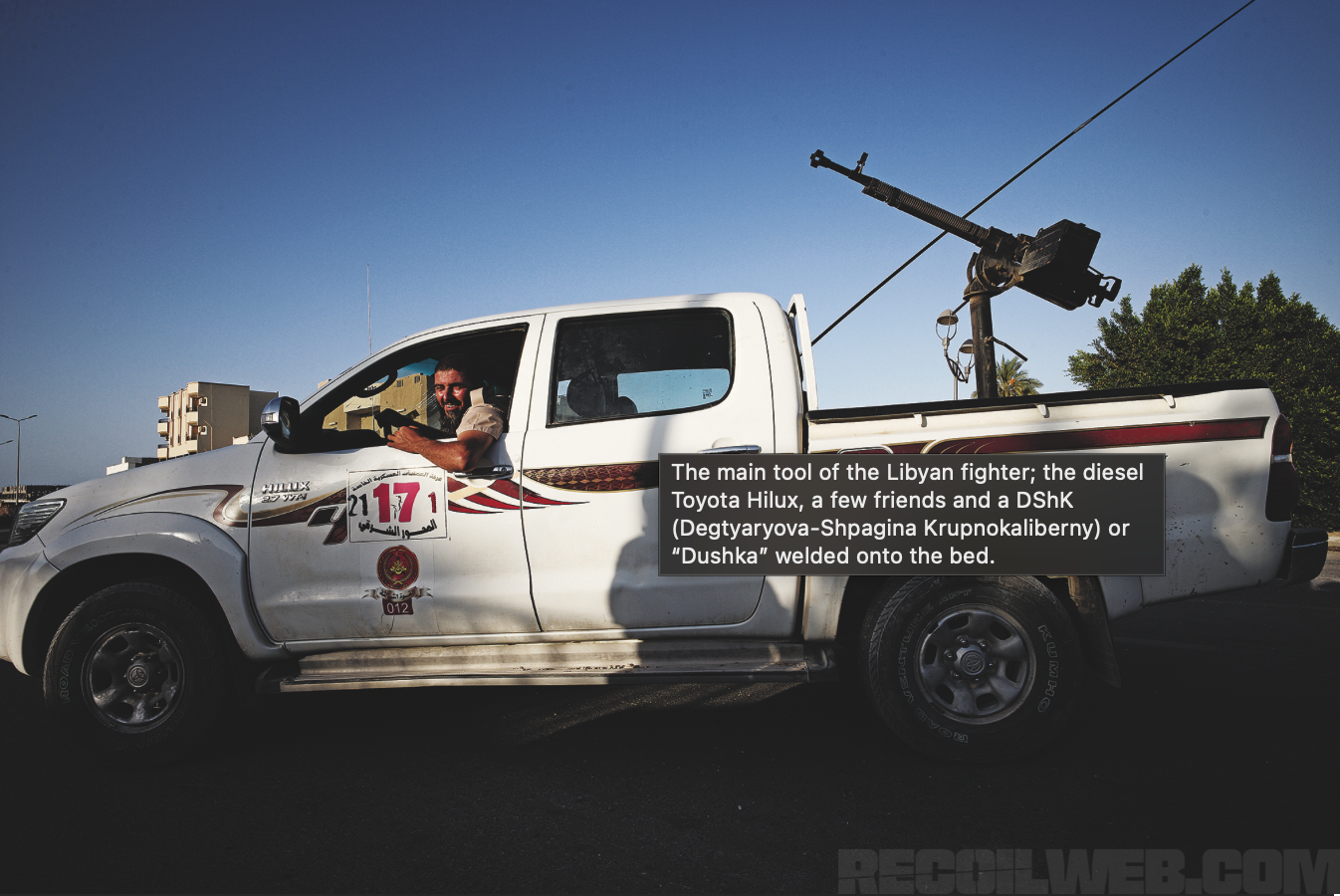
The star of the show was the AGM-176 Griffin in the Block II B version. The 45 lb, 42-inch long by 5.5-inch diameter missile carried a 13 pound warhead. Small that three Griffins could be mounted in place of one Hellfire and that meant that a 17-million-dollar a copy Reaper could pack four Hellfire missiles and two 500 lb GBU-12 Paveway II laser-guided bombs. The Griffin also can use its laser seeker or be programed to use GPS to provide a 12-mile range. The downside is that every Griffin launched is about $100K of taxpayer’s money used to take out a member of ISIS. Not much less than the $110K Hellfire but cheaper than tasking five B2 bombers to fly half way around the world as we will see later, but not cheap by ISIS choice of primitive weaponry and PR force projection.
The cell phone service was cut off by the Task Force, but the internet and internet cafés were allowed to operate. Foreign ISIS members would trudge down to the internet cafés and brag to their girlfriends while watching porn and being recorded in real time by TF operators. “There were Americans, Brits, Australians, all kinds of foreign volunteers,” a source remembers. “Once they plugged their phones in, every phone number and photo was sucked up into the databases.” Once the ISIS fighters left the café, it was easy to lock in ISR and wait until they were well away from civilians. The whir and loud bang of the Griffin became a familiar sound, but they never figured it out.
Single targets would be driving down the road or walking down the street, only to be vaporized by a drone buzzing high overhead.
Despite the high tech, air strikes from drones don’t always go as planned. One man was targeted. The missile exploded behind his car, but he kept driving. The operator fired again. Because the drone wasn’t flying at a flat angle, the missile hit the car’s bumper. The target stopped, got out of his car, looked up, and then ran for his life. He jumped into a hole and was hit again. After the dust settled, the ISR operators watched him brush himself off and keep running..
Although the 9-month ground campaign to retake Mosul would not start until October 2016 and would continue until July 2017, Task Force Nine Dot Three had degraded the Islamic State to the point that local militias could begin the bloody building-to-building clearing process.
LIBYA
“I am the son of a martyr and the father of a martyr,” the chiseled-jawed Libyan commander began his discussion with me. The sounds of sporadic gunshots underscored the heat in the coastal city of Sirte. It was August 2016, and I was in Sirte, Libya, watching the commander and his militia kill ISIS. Here, in Gaddafi’s hometown (technically he was born south of here in a tent), was their last hold. A Misratan coalition of around 5000 fighters, called Al-Bunyan al-Marsus (“The Solid Structure” or “Stronger Together”), was the chosen ground force to grind against ISIS. Learning a lesson from Syria, British and American special operations teams stayed well out of sight. The presence of foreigners was evident in the snappy logo, the press releases, and the carefully controlled media access. After all, it is not pretty killing ISIS, and America wants the locals to do the dying and take the credit. ISR flights had begun in earnest in December 2014, and by August 1, air strikes, many from a Marine ship offshore, had begun. The official version was called Operation Odyssey Lightning, during which AV-8B Harriers and Cobra gunships assigned to the 22nd MEU aboard the USS Wasp provided support to ISR and spotters.
The ISIS holdouts, mostly Tunisians, carried out numerous suicide attacks and also used sniper positions inside apartment blocks, while forcing civilians to remain inside the buildings they fought from by setting thousands of booby traps.
When the Misratans closed in, the ISIS leadership had already headed south into the desert, leaving behind hungry, haggard defenders willing to die. When the ISIS holdouts were finally flushed out, they would receive the full anger of Libyans who had lost friends to snipers and booby traps. My requests to interview prisoners were always met with polite smiles.
Anyone who wanted to get into the war had to stop at the “Bunyan Marsous” operations center (set up in May 2016). Not surprisingly, a Byzantine trail of paperwork, stamps, and approvals lay ahead. The idea was to prevent unfriendly nations from covering the war and to encourage those backing Bunyan Marsous.
““Your Americans” is how official spokesman General Mohamed al-Ghasry proudly described them to me. “…can drop a bomb on the top while our fighters are clearing below.” A few minutes earlier, al-Ghasry had rudely told another news crew from another nation in our meeting room that there were no foreigners in Sirte. He was careful to block certain media outlets from accessing Sirte. “They are spies,” he said, describing another group after abruptly closing the conference room door in their faces, as they began to dish on the secret war in Sirte. “We love the Americans,” he exclaimed. He said that just that day, with the aid of those precision strikes, the Libyans had managed to seize the massive white-and-black-striped Ouagadougou conference center. The next day, news of Americans supporting the Libyan militia against Sirte to take the shopping-mall-sized center spread around the world.
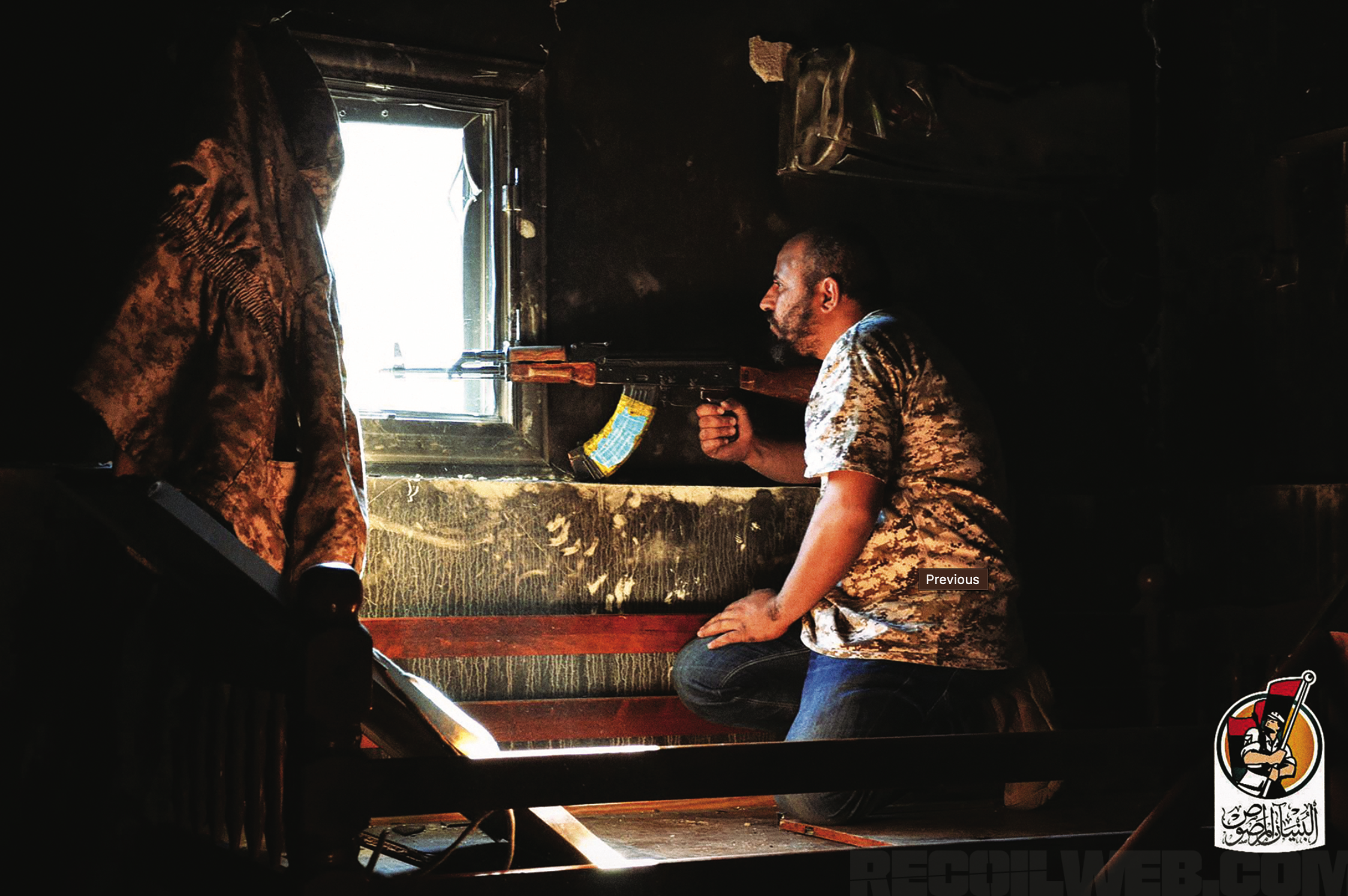
On the battlefield, the Bunyan Marsous militias were about 20% actual military veterans, with the rest eager young men using Toyota pickups, heavy machine guns, and anti-aircraft guns welded to the beds.
It was a giddy moment for the Libyans until they realized the extent of the booby traps left behind by “Daesh,” as they are called here. “They left them under carpets, behind doors, under dead bodies. They are everywhere. We need help with this,” al-Ghasry complained. Casualties were another factor in how aggressively the militia could prosecute the war. There are only 20 beds, three hours away in Misrata. Only after the hospital had flown patients to Turkey and made room could they launch another assault. It was the booby traps that wounded and killed the fighters in this phase.
ISIS was deploying its worst tactics as dozens of car bombs appeared, some abruptly pulling out of garages in front of advancing troops. ISIS had learned the hard way that driving up to roadblocks made them perfect targets for wire-guided missiles, so it stopped sending attackers from a distance. ISIS was deadly and adaptive. One day, a feel-good story published online about a popular snack shop in Sirte providing free meals for fighters triggered a car bomb attack the next day. ISIS parked a car outside the food center and killed scores of fighters.
To understand whether the agony of Sirte and ISIS’s nihilistic approach are foreshadowing further showdowns, I drive to the edge of Misrata to a dusty compound where Anwar Suwan holds court. Suwan is a local legend, the “logistics” man who put Gaddafi’s body in his meat locker in Misrata. It was his last act, which gave the world a gruesome view of what happens to strongmen who challenge the West. Tonight, in the cool Libyan night, everyone sits outside on carpets. Suwan checks his iPad and talks loudly on his phone. Suwan is known for great company and great food. He doesn’t disappoint tonight, as three-foot-wide dishes of sheep and beef are passed around.
Suwan occasionally breaks into stentorian tones and points his index finger in the air as if speaking on television. He is not just talking for my benefit, the curious Westerner; he is also entertaining his guests, wealthy businessmen, diplomats, soldiers, and friends. He bemoans the lack of a government, unity, or even a hopeful future for his country. A common theme is that of an oil-rich nation of only six and a half million people that fought a revolution for freedom but still can’t get it together after 42 years under Qaddafi and almost half a decade of freedom.
The men in starched jalabas sit on pillows and nod, then break off into unrelated conversations. It’s all very Libyan. Suwan breaks in, “Gaddafi was the state, and when they killed Qaddafi, they killed the state. We had no idea how to run a state.”
Around me are militia fighters, diplomats, Gaddafi loyalists, and soldiers. Technically, everyone here is for and against Gaddafi. And now they miss him. They viewed Libya as a unified force, a wealthy country with free education, health care, and other subsidies. Now there is only chaos. The problem is that outsiders continue to meddle in Libya’s economy and security. This includes Islamist, criminal, American, and European forces, all with different ideas. A government official who no longer has a government leans toward me and says, “The solutions should come from inside Libya, not from the outside.”
An older, chain-smoking military officer sitting to the left of me turns out to have been Qaddafi’s personal cameraman for 38 years. He is the spokesman for the third force based in Sabha. “Sabha is very poor, so it is criminal. We want to arrest smugglers, but when you hear their story, you let them go. They just want to feed their families. The petrol and water come from the south, but they get nothing back. Just the exhaust.” He laughs the dry, chain-smokers’ laugh.
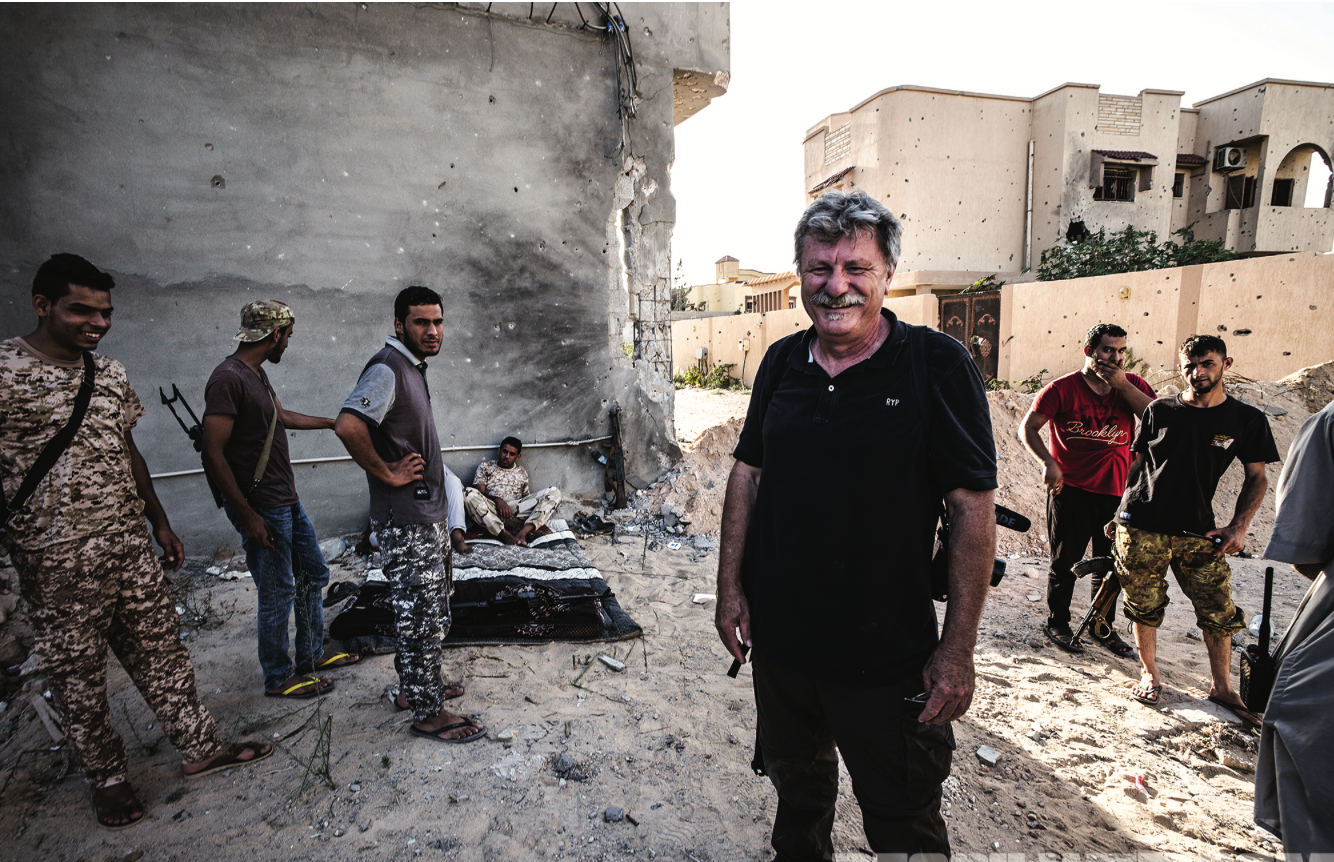
I ask to take Anwar’s photo, but he tells me to wait and puts on his trademark wool hat. "People won't recognize me without my hat.” Everyone laughs. Nothing was solved tonight, but Suwan will make sure fighters get fed on the front lines in Sirte, using ladies to cook and pack individual lunches in Styrofoam boxes, then driven the three hours to the front lines.
Like I said, Libya is complicated.
SABRATHA
In February 2016, America struck again, this time with F-15E fighter-bombers based in Lakenheath, England, backed up by drones, dropping two bombs in a rural neighborhood south of Sabratha. The target was a “training camp,” in reality a halfway house near Sabratha, killing more than 49 of the 60 or so mostly Tunisian fighters, including Saifallah Ben Hassine and 36-year-old Tunisian Noureddine Chouchane.
The raid also killed two kidnapped Serbians, embassy communications officer Ladjana Stankovic and his driver, Jovica Stepic, in the bombing in the early hours of Friday morning. The Serbians had been kidnapped in November after they were rear-ended and then dragged off by kidnappers. The Serbian ambassador escaped. The Serbians were preparing to launch a raid using a Salafist Libyan militia called the Radha Brigade but did not communicate their location to the Americans. However, the U.S. continues to use Presidential findings and the authorization of U.S. military forces signed in 2001 as reason enough to engage terrorists in any location on earth. More importantly, this strike very publicly opened a fourth front against ISIS after Iraq, Syria, and Afghanistan.
ISIS took revenge by attacking the city of Sabratha, again a sleepy seaside town of 100,000 people, 40 miles west of the capital, Tripoli, and about seven hours (528 km) from Sirte.
The first thing I noticed when I wandered through the rubble of the ISIS target was that this “terrorist training camp” could have been in a rundown rural neighborhood in any desert city. It was neither remote nor even that far from neighboring houses. The men who lived here kept to themselves and kept their vehicles under the now-destroyed, twisted blue metal awnings. This was where the attackers in the Tunisia terror attacks on tourists were said to have trained.
I found a bizarre “ring of fire” training hoop stuck in a metal truck rim and evidence that yes, this was a rudimentary PE training camp used to funnel recruits from Tunisia in the west towards Sirte.
ISIS took revenge five days later, driving their trucks through town, attacking the police station, beheading 12 policemen, killing seven others, and then driving back off to the desert.
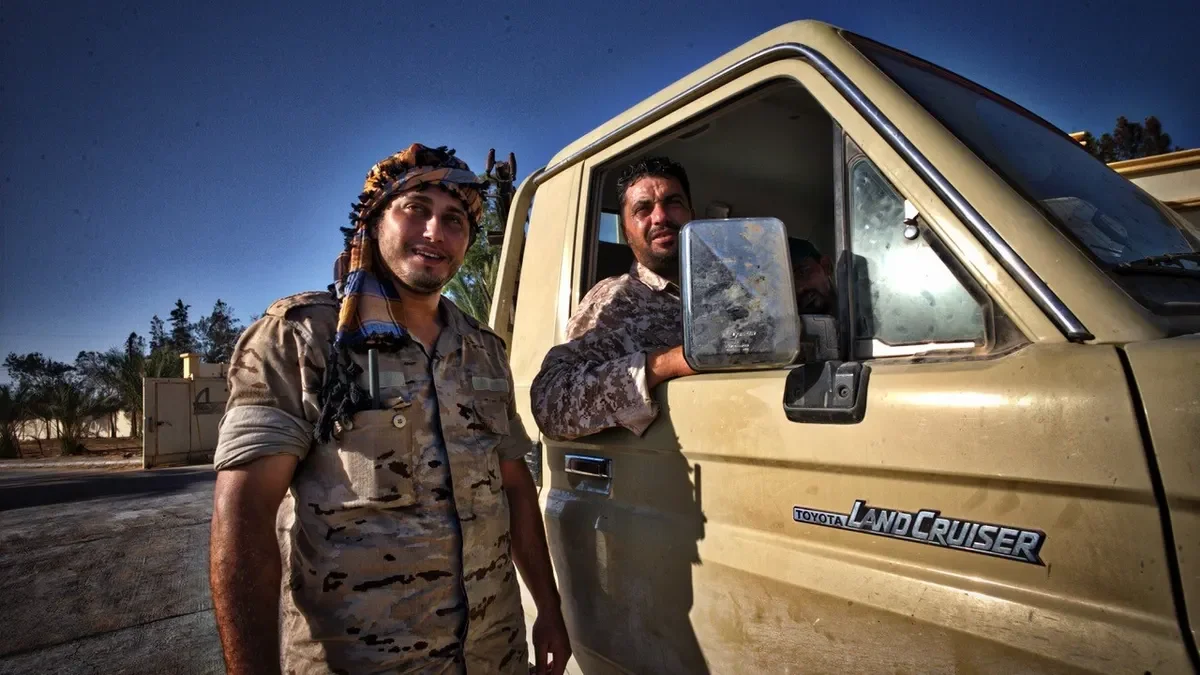
The ground militia moves in only when the bombng and sniping are done. ©RYP, all rights reserved
It was not the end of ISIS in Libya.
On 18 January 2017, bombs fell from the sky. Five B2 bombers were loaded with around 400 bombs, and the air crews were readying for a long flight. KC-10 Extenders and KC-135 Stratotankers coordinated between the East Coast of the US and Europe to refuel the bombers to the target and back. Three B2s took off, and two dropped 85 bombs as Reapers sent back real-time video. When the Libyan militia rolled up in their gunned-up Toyota Land Cruiser pickups, they found the bodies or pieces of around 90 Daesh.
During my last trip to Libya, ISIS had been cleared from Sirte, but every night on the Misratan news casts, ISIS sightings, complete with little computer graphic trucks with ISIS flags, would be displayed like a weather report. ISIS would pop up at checkpoints and be seen in the remote desert south of us. I arranged a trip to see if I could find Daesh in an old abandoned air base where they had been spotted. The vastness of the Libyan desert is impressive, but not as impressive as coming upon a massive space shuttle runway in the middle of nowhere. A few nomads had set up camp, and I asked if Daesh had come this way. Nope, no Daesh